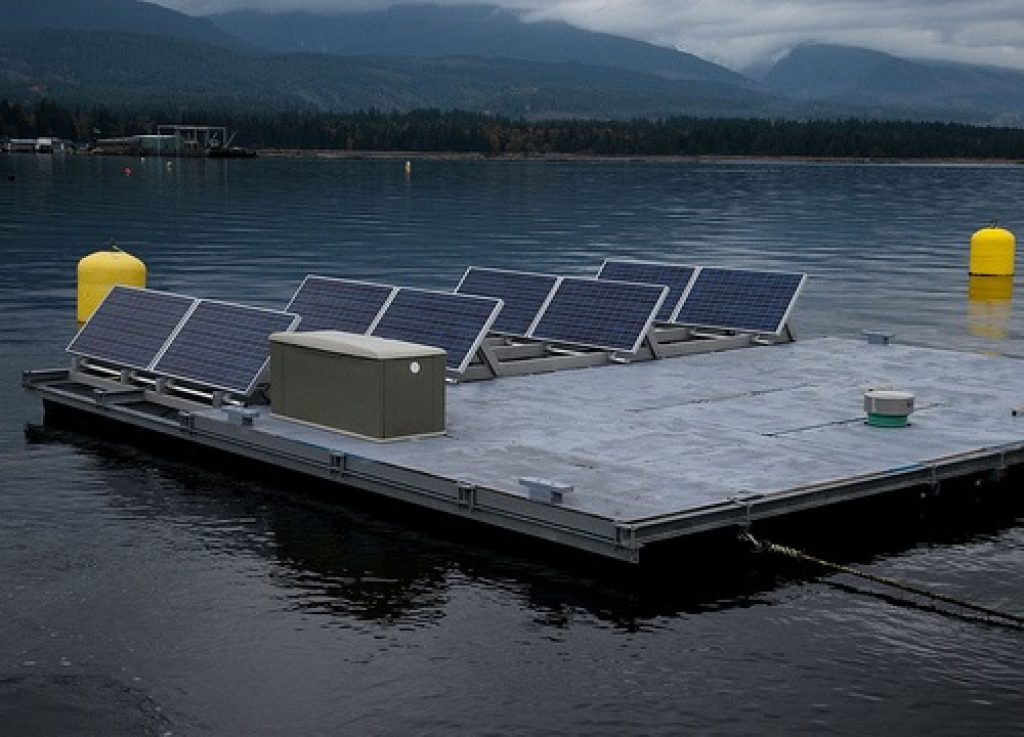
AsianScientist (Sep. 8, 2014) – With real estate becoming an increasingly scarce and expensive commodity, companies in Japan and India have taken the push for solar energy beyond land—and onto water.
The surfaces of water bodies such as lakes and reservoirs have little practical use. As such, constructing a floating solar farm on these water bodies not only exploits an underutilized commodity; it also frees up expensive, scarce land for other uses. Further, due to the cooling effects of the water bodies they are located on, floating solar panels are thought to be more efficient than panels located on the ground, or on rooftops.
In India, the state-owned National Hydro Power Corporation will build a floating power station in the southern Kerala region. The project is estimated to cost upwards of US$40 million, and will have a final capacity of 50 megawatts. This will make it the largest solar farm of its kind in the world.
“There are large stretches of water bodies in Kerala which NHPC wants to harness for solar power,” said Dr. S.P. Gon Choudhury, chairman of the Renewable Energy College, to The Economic Times. “This floating solar power technology was developed by the Renewable Energy College and has been implemented in the city.”
Pilot operations are scheduled for October of this year. If successful, the project might expand to other southern regions in India, where large water reservoirs abound.
Meanwhile in Japan, Kyocera Corp. and Century Tokyo Leasing Corp. plan to build two floating power farms of their own, in a bid to construct large-scale solar projects without exacerbating the nation’s perpetual land shortage.
The facilities—with 1.7 megawatt and 1.2 megawatt capacities respectively—are scheduled to begin operating in April 2015 in western Japan’s Hyogo Prefecture. According to Bloomberg, this joint venture aims to construct about 30 stations, each with 2 megawatts of capacity.
Kyocera Corp. and Century Tokyo set up a venture in August 2012, with the goal of developing solar power plants in Japan totaling 90 megawatts in capacity. Thus far, 22 megawatts worth of projects have already kick-started operations.
—–
Copyright Asian Scientist Magazine; Photo: VIUDeepBay/Flickr/CC.
Disclaimer: This article does not necessarily reflect the views of AsianScientist or its staff.