AsianScientist (Jun 5, 2014) – An international team of scientists has successfully unravelled the chemical reaction driving microscopic crystals to leap distances hundreds of times their own size when exposed to ultraviolet (UV) light. These findings have been published as the cover story in the journal Angewandte Chemie International Edition.
This conversion of light into mechanical motion is the first instance of a “photosalient effect” driven by a photochemical reaction in solids to be reported. The rare phenomenon provides a new way to transfer light energy into mechanical motion, and potentially offers a fresh approach to harness solar energy to power light-driven actuators and mechanical devices.
While studying metal complex polymerisation in the solid state, Mr. Raghavender Medishetty, a PhD candidate, and Ms. Bai Zhaozhi, a third-year undergraduate student, of the Department of Chemistry at the National University of Singapore (NUS), found that very tiny crystals leap violently when exposed to UV light. Interestingly, even when the crystals are irradiated with weak UV light, the single crystals burst violently to travel up to hundreds of times their sizes.
To understand the reactions behind the self-actuation of the crystals, the NUS team worked with a research team from the New York University Abu Dhabi to capture the rapid motion of the crystals with an optical microscope coupled to a high-speed camera. They also collaborated with a research team from the Max Plank Institute for Solid State Research in Germany to model the kinetics by time-resolved powder X-ray diffraction methods.
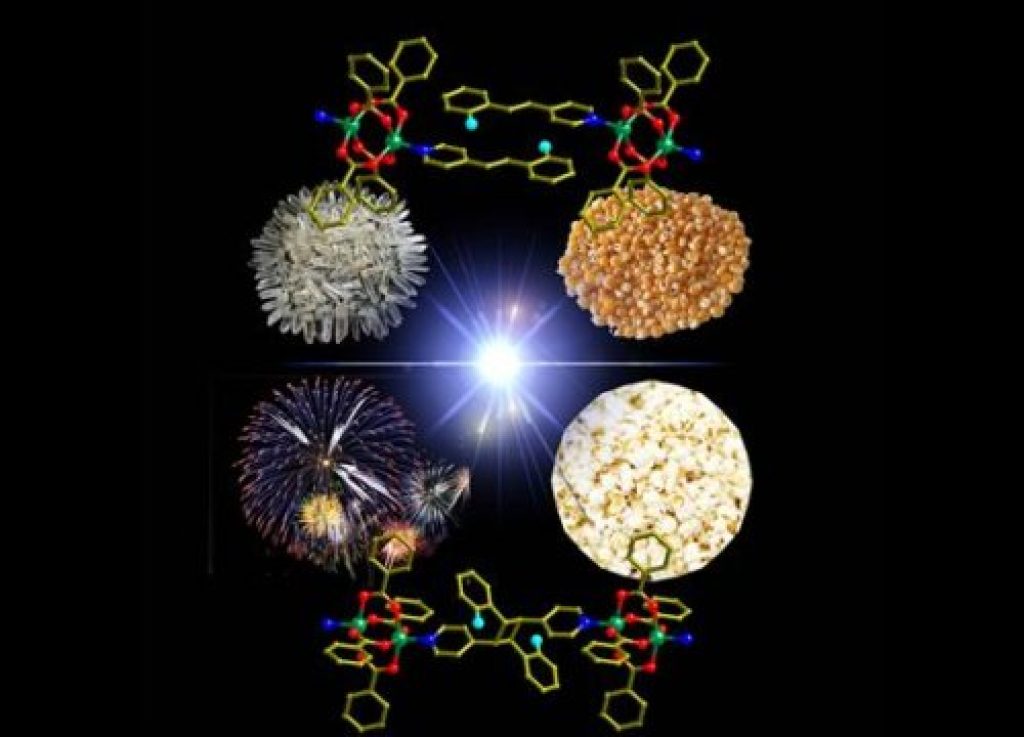
The researchers discovered that the cause for the popping and disintegration of these single crystals was due to the strain generated during the photochemical reaction in the crystal, leading to the formation of metal coordination polymers. Sudden expansion of volume during this reaction results in the release of the stress in the form of ballistic events. Such a chemical reaction is very similar to the popping of corn kernels on a hot plate as a result of rapid expansion of the inner kernel compared to the outer shell.
Elaborating on the findings, Prof Vittal said, “Photoactuated movements are induced by the application of light to certain type of crystals, but they are observed to be less efficient than the biomechanical motions of plant and animal tissues. In our work, we observed that the conversion of energy in the crystals may be able to mimic the motility of biological systems and provide a new way to transfer light energy into mechanical motion.”
He added, “Our work validates that the so called “bad” UV light from sources such as the sun can be utilised to convert chemical reactions to drive mechanical motions with practical uses. Knowledge and application of such behaviour is very important towards addressing the global energy crisis.”
The team hopes to eventually develop new materials that could convert solar energy effectively into mechanical energy. In addition, the team also hopes to leverage the principle of the photosalient effect to create a new source of reversible chemical energy by controlling the shape and size of crystals used for energy conversion.
The article can be found at: Medishetty et al. (2014) Single Crystals Popping Under UV Light: A Photosalient Effect Triggered by a [2+2] Cycloaddition Reaction.
———
Source: National University of Singapore.
Disclaimer: This article does not necessarily reflect the views of AsianScientist or its staff.