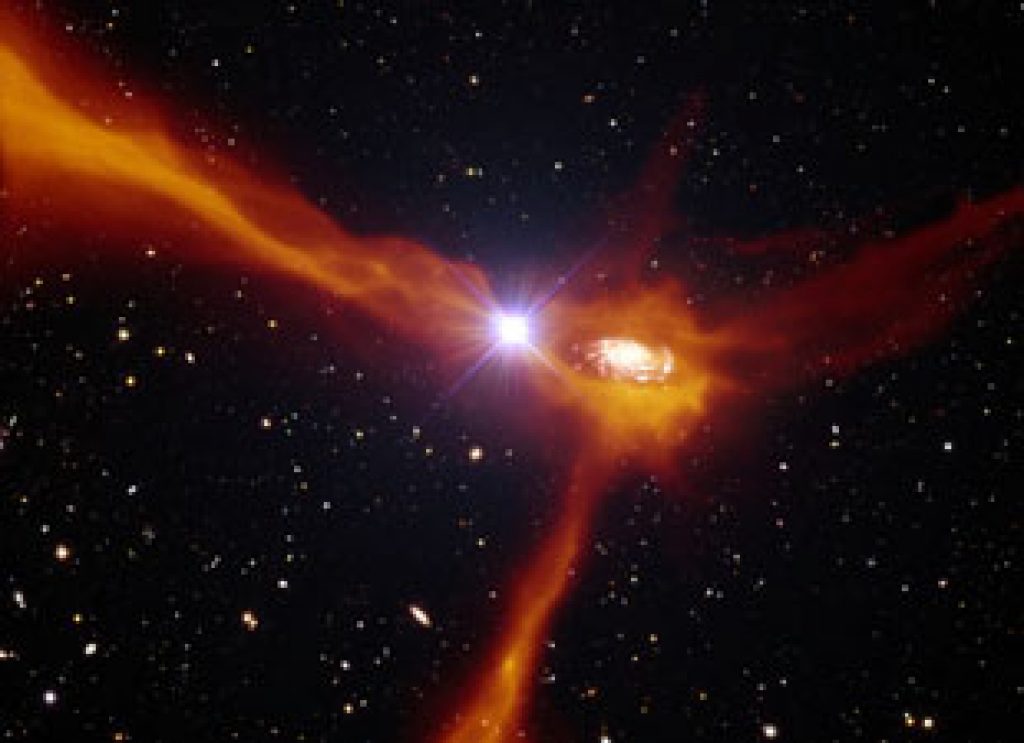
AsianScientist (Jul. 9, 2013) – An international team of researchers has used one of the world’s largest telescopes to spot a distant galaxy hungrily snacking on nearby gas.
A flow of gas appears to be spiraling into the galaxy, providing the fuel to create new generations of stars and to drive the galaxy’s rotation.
The research team, led by Dr Nicolas Bouché from the Research Institute in Astrophysics and Planetology in France, includes Associate Professor Michael Murphy and Dr Glenn Kacprzak, an Australian Research Council Super Science Fellow, both from Swinburne University of Technology in Australia.
Associate Professor Murphy said that this was some of the best observed evidence supporting the theory that galaxies suck in and devour nearby material in order to grow and form stars.
“It’s like feeding time for lions at the zoo. This particular galaxy has a voracious appetite, and we have discovered how it feeds itself to grow so quickly,” he said.
Galaxies quickly deplete their reservoirs of gas as they grow and create new stars, so they must continuously replenish this with fresh gas from intergalactic space to keep the process of star formation going.
“Usually, we do not know whether the gas is coming in or moving out. In this case we have strong evidence for gas fueling the galaxy rather than it being expelled in galactic superwinds,” Dr Kacprzak said.
Using the European Southern Observatory’s (ESO) Very Large Telescope in northern Chile, the team of astronomers was able to see directly how the galaxy itself was rotating. However, measuring the composition and motion of the gas outside the galaxy required a special alignment with an even more distant ‘quasar’ – the bright center of a galaxy powered by a supermassive black hole.
“This kind of alignment is very rare and it has allowed us to make unique observations,” Dr Bouché said.
The article can be found at: Bouché N et al. (2013) Signatures of Cool Gas Fueling a Star-Forming Galaxy at Redshift 2.3.
——
Source: Swinburne University of Technology; Photo: European Southern Observatory.
Disclaimer: This article does not necessarily reflect the views of AsianScientist or its staff.