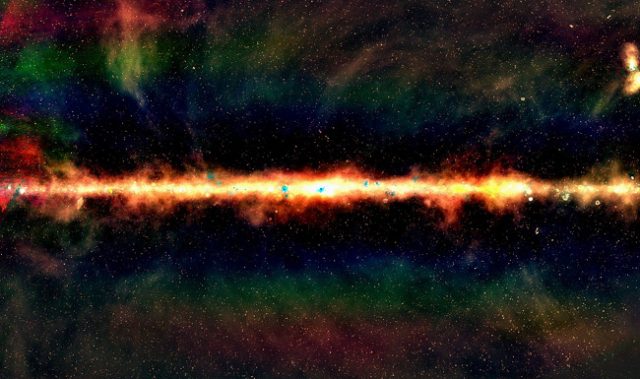
AsianScientist (Sep. 16, 2011) – Australia and New Zealand have submitted their joint written proposal on Wednesday to host the Square Kilometer Array (SKA), the most powerful radio telescope ever conceived and one of the most ambitious projects of our time.
Sites in both Australia and South Africa have been shortlisted to host the central core of the SKA telescope.
If located in Australia, the SKA antennas would extend as far as New Zealand and if located in South Africa, the SKA antennas would extend to the Indian Ocean islands.
Australia and New Zealand’s submission is the result of a major collaborative effort between 47 agencies across the two countries.
On August 21, 2009, the two governments signed a formal arrangement towards a joint bid for the AU$2.5 billion (US$2.59 billion) international project.
Australian Innovation Minister Senator Kim Carr and New Zealand Economic Development Minister David Carter said hosting the SKA would put Australia and New Zealand at the forefront of international science.
“This is an amazing opportunity for Kiwis to be involved in a world-leading project that pushes the boundaries of scientific discovery,” Senator Carter said. “The region has a long tradition of excellence and innovation in radio astronomy that goes right back to the birth of the field.”
Senator Carr described the proposed site as a remote site based in Western Australia with exceptional radio quiet characteristics and superb astronomy infrastructure.
To allow SKA signals to be processed and transmitted, Australia’s National Broadband Network is rolling out the necessary fiber-optic links, Senator Carr added.
Mr. Carter hoped that there will be innovation and science spinoffs for both countries – ones that may inspire a new generation of scientists like the great Ernest Rutherford.
A decision on the location of the SKA site will be made in 2012 by the Site Selection Group, which has been established to oversee the process of evaluating the information on each candidate site.
Site selection criteria include: radio frequency interference, characteristics of the ionosphere and the troposphere, climate and subsurface temperatures of the site, connectivity and communications networks for worldwide data distribution, infrastructure costs, operations and maintenance costs, and long term sustainability of the site as a radio quiet zone.
The SKA is expected to become fully operational in 2020.
——
Source: Ministry for Innovation, Industry, Science & Research, Australia; Square Kilometer Array.
Disclaimer: This article does not necessarily reflect the views of AsianScientist or its staff.