AsianScientist (Oct. 25, 2018) – A research group at the Korea Advanced Institute of Science and Technology (KAIST), South Korea, has found that human body temperature can be more accurately estimated when skin hardness is taken into consideration. They published their findings in Scientific Reports.
Under the same temperature and humidity, human thermal status may vary due to individual body constitution and climatic environment. Hence, skin temperature and sweat rate fall short of providing an exact estimation of human thermal comfort. An additional indicator is required for enhancing the accuracy and reliability of estimation.
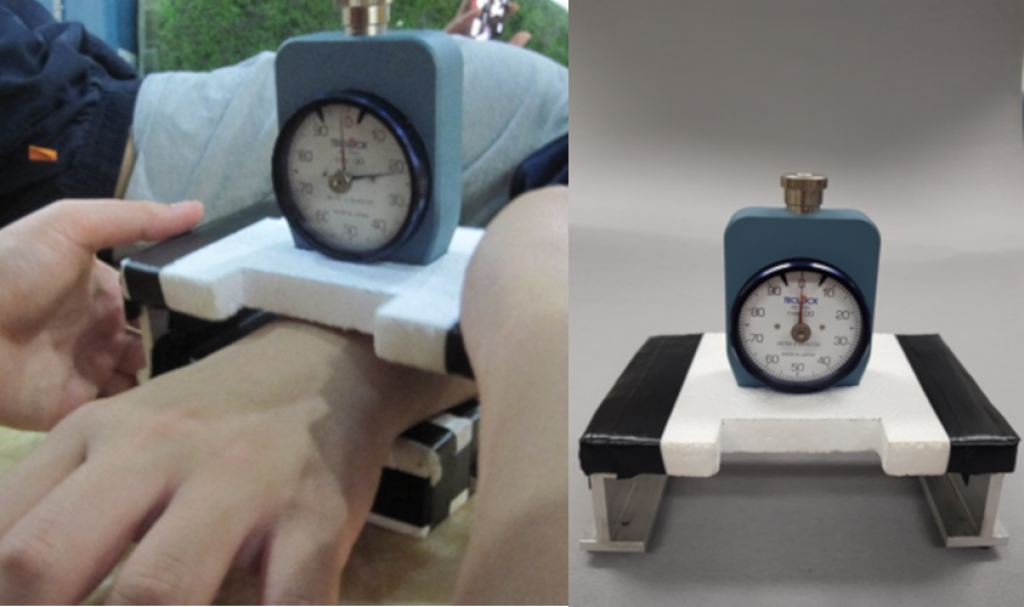
In the present study, researchers led by Professor Cho Young-Ho and his team from the Department of Bio and Brain Engineering at KAIST proposed skin hardness as an additional, independent physiological sign to assess human thermal status more accurately. When people feel hot or cold, arrector pili muscles connected to hair follicles contract and expand. This results in changes in skin hardness, which is measurable.
With a model that relies on skin temperature, sweat rate and skin hardness to estimate human thermal status, the team conducted human experiments and verified that skin hardness is effective and independent from the two conventional physiological measurements. Including skin hardness as a parameter reduced temperature estimation errors by 23.5 percent.
“Introducing skin hardness elevates the reliability of measuring human thermal comfort regardless of individual body constitution and climatic environment. Based on this method, we can develop a personalized air conditioning and heating system,” said Cho.
The team intends to develop a sensor that detects skin hardness and apply it to cognitive air-conditioning and heating systems that better interact with humans than existing systems.
The article can be found at: Yoon et al. (2018) Evaluation of Skin Hardness as a Physiological Sign of Human Thermal Status.
———
Source: Korea Advanced Institute of Science and Technology.
Disclaimer: This article does not necessarily reflect the views of AsianScientist or its staff.