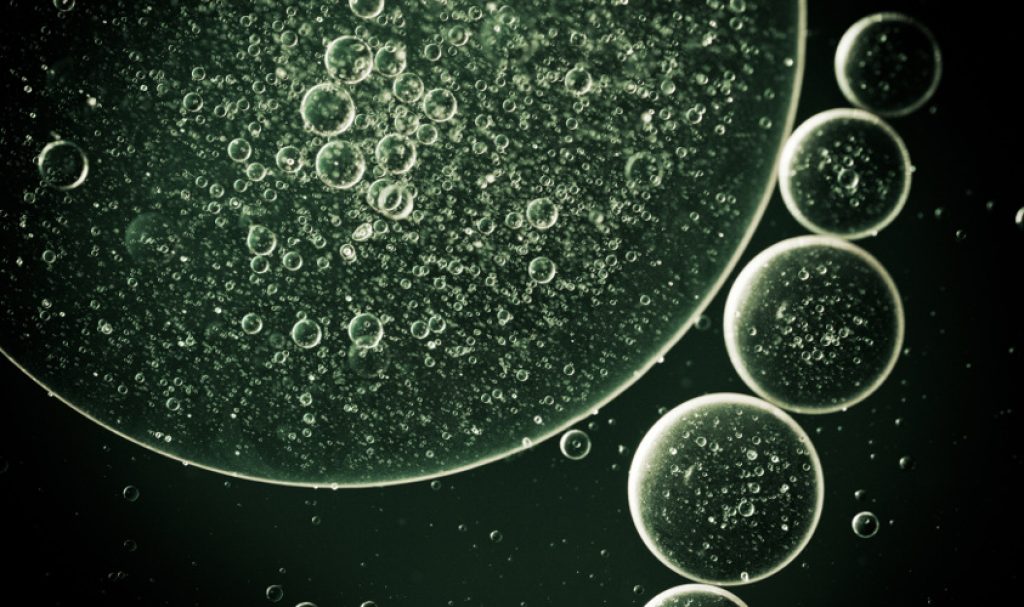
AsianScientist (Oct. 6, 2017) – Using molecular dynamic simulations, scientists in China have revealed how very tiny bubbles burst. They report their work in the journal Applied Physics Letters.
Nanobubbles have recently gained popularity for their unique properties and expansive applications. Their large surface area and high stability in saturated liquids make nanobubbles ideal candidates for food science, medicine and environmental advancements. Nanobubbles also have long lifetimes of hours or days, making them more useful than traditional macrobubbles, which typically only last for seconds. The stability of nanobubbles is well understood, but the mechanisms causing their eventual destabilization are still in question.
In this study, a group of researchers led by Professor Zhang Xianren at the Beijing University of Chemical Technology in China used molecular dynamics simulations (MDS) to explore the effect of surfactants—components that lower surface tension—on the stabilization of nanobubbles.
The researchers investigated the differences between soluble and insoluble surfactants and their varying influence on nanobubble stability using MDS software. They created a controlled model system where the only variables that could be manipulated were the number of surfactants and the interaction between the surfactant and the substrate, which refers to the base of the model where the bubble is formed. Using this method, they were able to measure the direct influence of surfactants on nanobubble stability.
Analyzing both soluble and insoluble surfactants, the group focused on two possible mechanisms of destabilization: contact line depinning, where the surfactant flexibility reduces the forces responsible for stabilizing the bubble shape, causing it to rupture from lack of inner surface force; and surface tension reduction, causing a liquid-to-vapor phase transition.
They found that soluble surfactants initiated nanobubble depinning when a large amount—roughly 80 percent—of the surfactant was adsorbed by the substrate, eventually causing the nanobubbles to burst.
“However, when small concentrations of soluble surfactant were introduced, it remained dissolved, and adsorption onto the substrate was insignificant, generating a negligible effect on nanobubble stability,” said Zhang.
Simulations with insoluble surfactants showed comparable results to soluble surfactants when interacting heavily with substrates, but a new mechanism was discovered demonstrating a liquid-to-vapor transition model of bubble rupture.
The transition is similar to how we traditionally envision bubbles popping, occurring when a surfactant significantly reduces the surface tension on the outside of the nanobubble. Nanobubbles destabilize in this fashion when a large amount of surfactant is present, but only 40 percent of the surfactant interacted with the substrate.
These findings are critical to understanding nanobubble stability and have implications for nanobubble interaction with other molecules, including proteins and contaminants. Nanobubble applications could revolutionize aspects of modern medicine such as ultrasound techniques, expand functions in food science and improve waste water treatment. Nonetheless, the researchers note that better characterization of basic properties like instability is essential to maximizing the potential of nanobubble applications.
The article can be found at: Xiao et al. (2017) How Nanobubbles Lose Stability: Effects of Surfactants.
———
Source: American Institute of Physics; Photo: Pexels.
Disclaimer: This article does not necessarily reflect the views of AsianScientist or its staff.