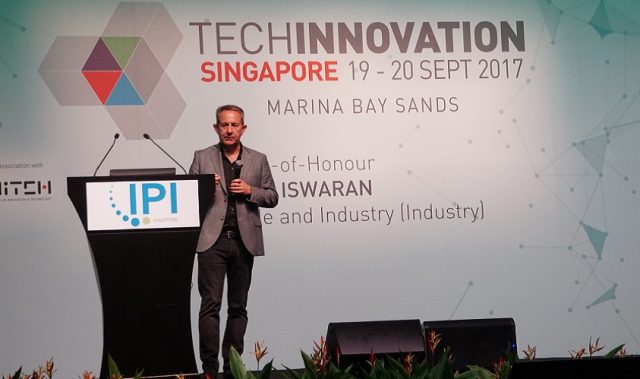
AsianScientist (Sep. 22, 2017) – According to Mr. Michael Milken, chairman of the eponymous Milken Institute, there is no better place in the world to look at the jobs of the future than Singapore. He made this encouraging statement while moderating a panel discussion on ‘Jobs in 2037: preparing for the future’ at the recent 2017 Milken Institute Asia Summit.
Milken recounted the story of Singapore’s late minister mentor and former prime minister Mr. Lee Kuan Yew, who had traveled to Jamaica to study its economy.
“Singapore and Jamaica had about the same per capita income at the beginning of the 1960s,” he said. “While Jamaica’s strategy was tourism and agriculture, Lee Kuan Yew’s was human capital—educate your own citizens, and invite and attract the best and brightest to come to Singapore.”
Lee’s strategy paid off, Milken said. Jamaica doubled its per capita income over 50 years, whereas Singapore increased its per capita income 25-fold over the same period.
The changing face of commerce
The distinguished panel of speakers consisted of Mrs. Josephine Teo, minister in the Prime Minister’s Office and second minister, Ministry of Manpower and Ministry of Foreign Affairs, Singapore; Mr. Joseph Tsai, executive vice chairman of Alibaba Group; Mr. Igor Tulchinsky, founder, chairman and CEO of WorldQuant LLC; and Mr. Jaime Augusto Zóbel de Ayala, chairman and CEO of Ayala Corporation.
“The common understanding of e-commerce is that it replaces or destroys a lot of jobs in the retail sector of the economy,” said Tsai, whose Alibaba Group is a dominant player in the e-commerce sector in China.
E-commerce is a boon to the Chinese economy, Tsai said, because it provided a sizable domestic sector to tap into when manufacturing exports dried up.
“Instead of replacing jobs in the retail sector, our perspective is that e-commerce created more jobs,” he said, adding that the Alibaba ecosystem generates about 55 million packages per day on their platform.
He also pointed out that retail, especially in the grocery sector, has changed dramatically.
“What’s happening in China today is that stores double as warehouses. You can have a store that serves walk-in customers, but that also has a warehouse section where you can fulfill online orders… That kind of architecture is very disruptive to large warehouses, and will change the way real estate developers develop their cities and malls.”
Not prescriptive, but supportive
Asked whose job it is to prepare the workforce of tomorrow, Teo said that Singapore is taking on the challenge differently. Instead of a top-down approach where the government prescribes which skills are required, it would instead facilitate an ecosystem for companies themselves to adapt and innovate.
These industry transformation maps, as they are called, would be a collaboration between government and industry, in verticals such as transportation, maritime services, finance, healthcare and retail, Teo said.
“We need businesses to lead the transformation and governments to help in the adaptation,” she said. “We want to [predict] how businesses will look like in five or ten years, and what kinds of things need to happen for [the companies] to raise productivity and innovation.”
And as these industries evolve, the government would step in to help individuals at risk of being displaced to receive the training required, she said.
Dealing with disruption
When third-party ride hailing apps such as Grab and Uber first came onto the scene, there was significant push-back from the taxi industry because their livelihoods were being disrupted, Teo said.
“On the one hand, there are people affected by the change who say, ‘We want protection from change.’ And yet at the same time, unless businesses develop new models of operating that are more efficient and that will exploit their potential to the fullest, you don’t have the ability to create better paying jobs for the citizens,” she added.
According to Teo, as new technologies appear and new regulation is required, governments should be willing to re-examine rules on a regular basis, in a manner that facilitates input from the public. In addition, governments should also help citizens adapt to the changes via training and social security.
“The future cannot be about businesses winning with technology and innovation at the expense of the people; neither can it be about people getting more protection against disruption at the expense of new business models,” she said.
Concluding the discussion, Milken said that the recent upheaval in the workforce is a continuation of a centuries-old phenomenon.
“Going to governments to seek protection against competition or change is something that people have done for hundreds of years,” he said. “It was no different when the nobility could not compete with the emerging class in England and went to the king or queen for protection.”
———
Copyright: Asian Scientist Magazine. Photo Credit: Milken Institute
Disclaimer: This article does not necessarily reflect the views of AsianScientist or its staff.