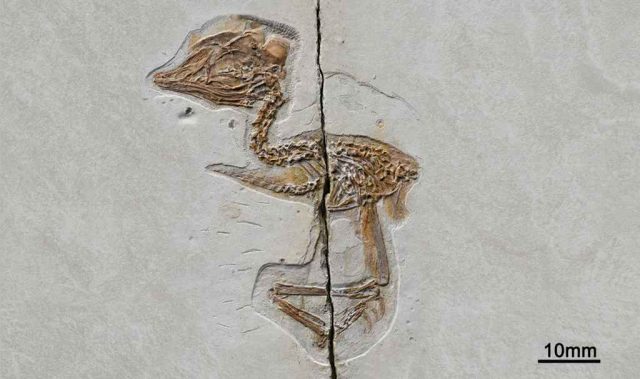
AsianScientist (Mar. 10, 2017) – Using lasers, scientists at the University of Hong Kong (HKU) have reconstructed the first highly detailed body outline of a feathered dinosaur by making it glow in the dark. These findings have been published in Nature Communications.
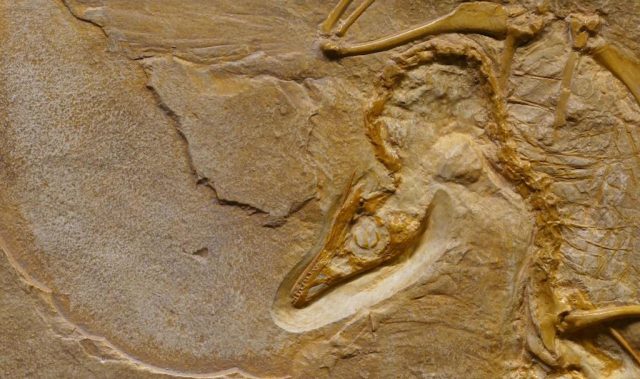
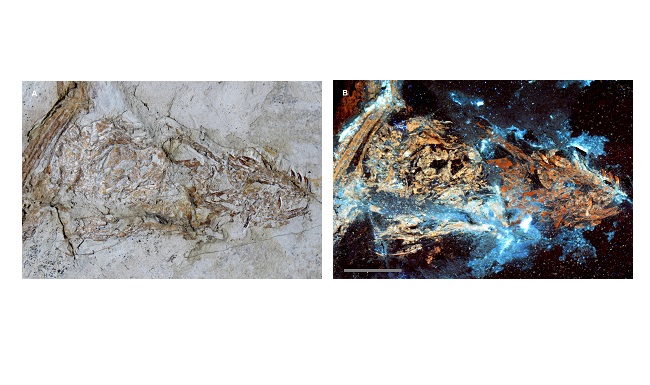
Until now it has been hard to get an accurate idea of the shape of a dinosaur from its fossilized remains, as only their bones are usually preserved. Instead, a team led by Dr. Michael Pittman from HKU’s Department of Earth Sciences used laser-stimulated fluorescence to obtain high-definition images of an Anchiornis fossil.
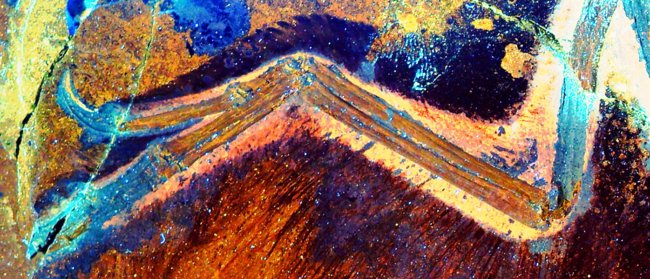
Laser-stimulated fluorescence uses high powered lasers to make unseen soft tissues that are preserved alongside the bones literally ‘glow in the dark’ by fluorescence. Developed by Pittman’s collaborator at the Foundation for Scientific Advancement, laser-simulated fluorescence involves scanning the fossils with a violet laser in a dark room. The laser excites the few skin atoms left in the matrix, making them glow to reveal the shape of the dinosaur’s soft tissues.
“For the last 20 years we have been amazed by the wondrous feathered dinosaurs of Northeastern China. However, we never thought they would preserve soft tissues so extensively,” said Pittman.
Pittman and his colleagues examined over 200 specimens of the feathered bird-like dinosaur Anchiornis to find the dozen with special preservation. The quantitative reconstruction shows the contours of the wings, legs and even perfectly preserved foot scales, providing new details that illuminate the origin of birds.
“The detail was so well lit that we could see the texture of the skin,” Pittman added.
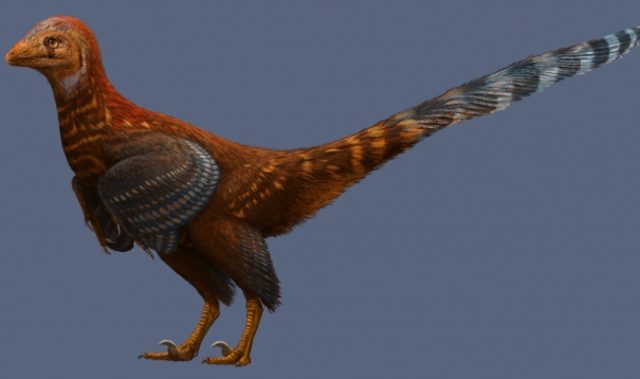
Anchiornis lived in the late Jurassic period (~160 million years old), close to the time when palaeontologists think birds first appeared. In recovering important soft tissue details of the wing in particular, Pittman and his colleagues found that the shape of wing was in many ways similar to modern birds, but it also had some seemingly primitive characteristics like feathers arranged more evenly across the wing rather than in distinct rows.
These new insights provide crucial information for reconstructing how dinosaurs experimented and eventually achieved flight. The new laser technique brings out hidden details because of the high intensity laser light. The team is already scheduling trips worldwide to fulfill requests to scan exceptional specimens.
The article can be found at: Wang et al. (2017) Basal Paravian Functional Anatomy Illuminated by High-detail Body Outline.
———
Source: University of Hong Kong; Photo: Julius T. Csotonyi.
Disclaimer: This article does not necessarily reflect the views of AsianScientist or its staff.