Try before you buy
The national center, which welcomes collaborations, has also enabled research that could potentially save the offshore and marine industry millions of dollars. Using NSCC facilities, researchers at the National University of Singapore’s (NUS) Technology Centre for Offshore and Marine are working on using computational fluid dynamics (CFD) to allow companies to try out their ideas before committing to build expensive ships and rigs.
“One of the big problems in the oil and gas industry right now is that the price [of oil and gas] is quite low. People are now searching for innovative ways to produce oil and gas at a lower cost but still do it safely,” Professor Allan Magee of the Centre for Offshore Research & Engineering at NUS, told Supercomputing Asia. “CFD simulations—coupled with physical testing—give companies design assurance that they haven’t missed any of the important physics.”
Noting that CFD is also widely used in fields such as airplane and building design, Magee said that the offshore and marine sector presents unique challenges that stretch HPC to the limit.
“Waves are among the most complex flow problems that exist in nature because it is an unsteady problem and the ocean is gigantic. We need to resolve turbulence at the millimeter scale—imagine trying to do that over a domain which is kilometers-long. So, obviously, it takes a very powerful computer to do that,” he explained.
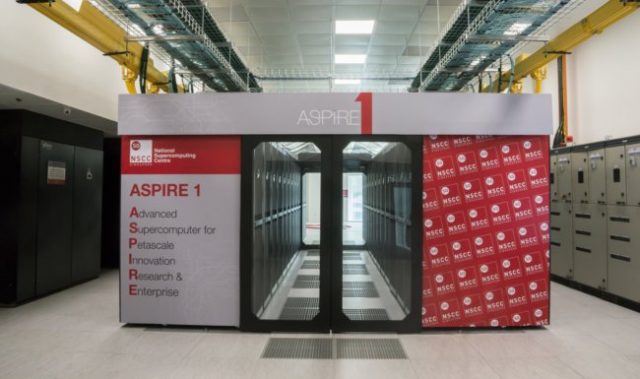
Thankfully, NSCC is up to the task. “Only developed nations have similar capabilities,” Magee added. “There’s nothing in Southeast Asia that I’m aware of that rivals it.”
Magee’s research has also benefited from NSCC’s highbandwidth network, the InfiniCortex
‘galaxy of supercomputers.’
“It provides a backbone or magnet which connects us to all other supercomputers throughout the world so that even if the local computer is not able to solve the problem we can connect to others that might be able to,” he said.
“This enables us to share data and computational power internationally, helping us to accomplish much more through synergy and collaboration.”
Democratizing HPC
Just as personal computers and mobile phones have improved connectivity across the board, supercomputing is expected to revolutionize entire industries and become widely used by researchers of all disciplines. Indeed, other researchers who have benefitted from NSCC’s services come from diverse fields, ranging from molecular dynamics to microbiology and genomics.
“NSCC’s long-term vision is to continually make HPC accessible to all, thereby democratizing HPC and building a healthy ecosystem of supercomputing users,” Lau said.
To encourage HPC adoption, NSCC conducts monthly training workshops that are customized to each user’s needs. They also organize events to raise the awareness of what HPC can achieve, including the inaugural NSCC Hackathon held in August 2016, where participants used supercomputers to solve problems faced by local start-ups.
Ultimately, NSCC is not just a useful resource but a facility run by researchers for researchers. “NSCC understands the requirements of us scientists,” said Barbot. “We don’t just work with them, we truly collaborate.”
If you are interested in signing up for a trial beta account to use NSCC’s HPC resources, please visit nscc.sg/contact-us or email [email protected] with the following information:
- Name of user
- Preferred User ID (limited to 8 characters)
- Designation
- Organization
- Nationality of user
- Purpose of using NSCC’s supercomputer
- Project name, if any
- Number of CPUcores hours required
- Number of GPUhours required
- Storage required (GB)
This article was first published in the print version of Supercomputing Asia, January 2017.
———
Copyright: Asian Scientist Magazine.
Disclaimer: This article does not necessarily reflect the views of AsianScientist or its staff.