AsianScientist (Aug. 16, 2016) – New fossil finds from China push back the origins of deep soils by 20 million years, according to researchers in China and the UK. The work was published in Proceedings of the National Academy of Sciences.
One of the greatest transitions in Earth history was the greening of the land. Up to 450 million years ago, there was no life outside water, and the land surface was a rocky landscape. Without plants, there were no soils, and the rocky landscape eroded fast.
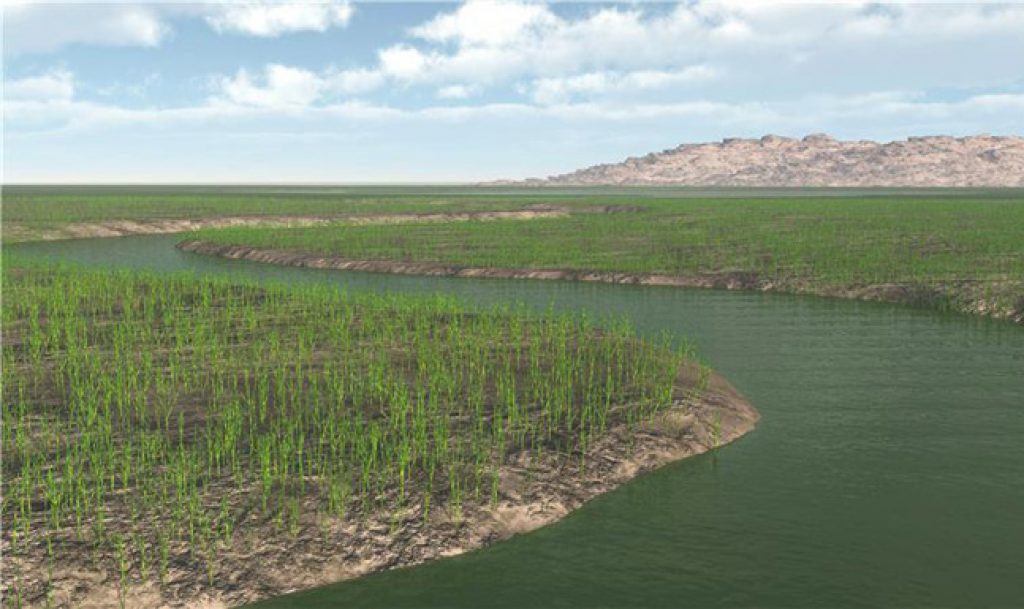
Then the first tiny plants crept out of the water, and provided a green fringe. However, they could not venture far from the edge of the water.
By 390 million years ago, in the Middle Devonian, the first trees emerged. These early trees were only a few meters tall, but they could survive in soils away from the edges of rivers and streams. Importantly, they sent roots deep into the rocks and helped develop thick soils, and the landscapes began to stabilize.
In the present study, researchers looked at deep rooting systems in Early Devonian rocks from the Yunnan province in South China. The roots are typically 1 cm in diameter, and they branch continuously. They are tightly packed, with as many as 1,000 roots in every square meter of sediment examined.
“We have been doing fieldwork in the Devonian rocks of Yunnan for some time, and we kept finding large-scale structures up to one meter deep in the red rocks,” said study leader Dr. Xue Jinzhuang from Peking University in Beijing.
These structures looked like the roots belonging to a plant called Drepanophycus, already known from rocks of the same age in Europe and North America.
Measurements of the soil thickness and comparisons with modern floodplain soils suggest it may have taken 50–200 years for one soil bed to form, during which the nodules helped to stabilize the soil.
Furthermore, nodules in the Chinese Devonian soils suggest that the stack of soils may represent a span of 10,000-200,000 years.
“These roots are found in deep soils, and in fact the two go hand in hand,” said co-author Dr. Mike Benton of the University of Bristol.
“Soils are made by plants and animals, and they have a great stabilizing effect, taking up rainwater like a sponge and limiting erosion rates. From this time onward, river systems changed their type, from fast-flowing, to slower-moving, meandering streams.”
The article can be found at: Xue et al. (2016) Belowground Rhizomes in Paleosols: the Hidden Half of an Early Devonian Vascular Plant.
———
Source: Bristol University; Photo: Deng Zhenzhen.
Disclaimer: This article does not necessarily reflect the views of AsianScientist or its staff.