AsianScientist (Jul. 15, 2016) – Japanese scientists have developed light-powered molecular motors that can repeatedly bend and unbend in the presence of blue light.
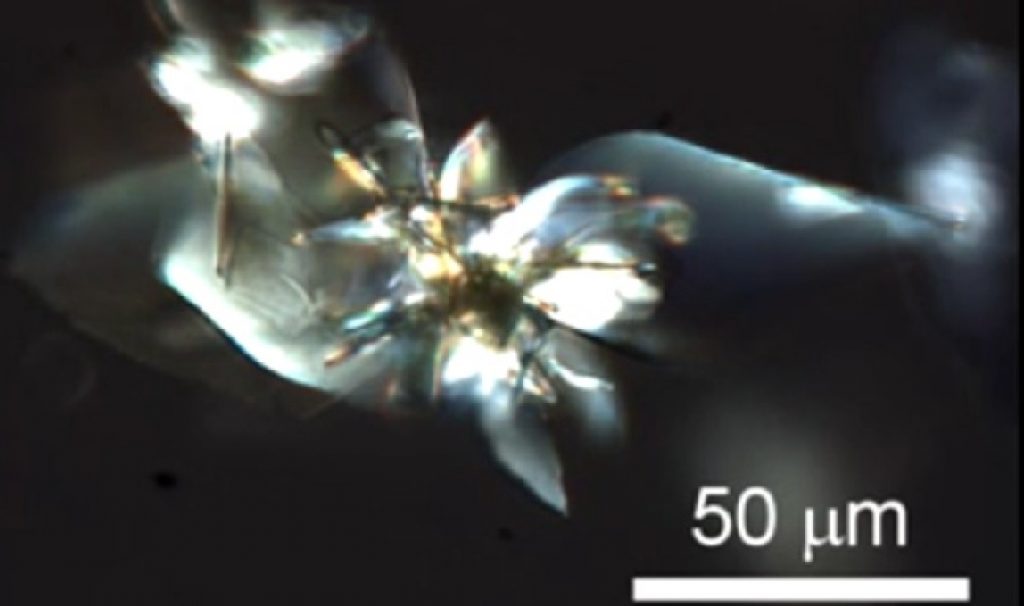
Drs. Yoshiyuki Kageyama, Sadamu Takeda and their colleagues at Hokkaido University’s Department of Chemistry have successfully created a chemical compound, or a crystalline assembly, which autonomously ‘flips’ again and again under blue light.
The crystals are composed of an organic compound called azobenzene (commonly used in dye manufacturing) and oleic acid (commonly found in cooking oil). Azobenzene molecules take two structurally-different forms that repetitively convert from one form to the other under blue light. The scientists tested if this feature would influence the structure of the azobenzene-oleic acid crystal, which contained unequal amounts of cis- and trans-azobenzene.
By applying blue light to the crystals in the solution, the scientists observed a continuous oscillatory bending-unbending motion of the thin crystals. When the light intensity was increased, so did the frequency of the motion. Some crystal complexes even exhibited ‘swimming-like’ motions in the water.
Previously reported light-responsive materials have been limited in their ability to deform. However, the properties of the compounds in the Hokkaido University-developed crystals allowed for a two-step switching mechanism, resulting in regular repetitive oscillations.
“The ability to self-organize rhythmic motions, such as the repetitive flipping motion we observed, is one of the fundamental characteristics of living organisms,” said Kageyama.
“This mechanism can be used in the future to develop bio-inspired molecular motors and robots that will find applications in wide areas, including medicine.”
The study was published in the journal Angewandte Chemie International Edition.
The article can be found at: Ikegami et al. (2016) Dissipative And Autonomous Square-Wave Self-Oscillation Of A Macroscopic Hybrid Self-Assembly Under Continuous Light Irradiation.
———
Source: Hokkaido University.
Disclaimer: This article does not necessarily reflect the views of AsianScientist or its staff.