AsianScientist (May 13, 2016) – Researchers have identified two genes linked to previously unexplained craniofacial anomalies (CFA), one of the most common congenital diseases. Their work was published in Cell Research.
CFAs affect the growth of the head and facial bones and account for about one-third of all human congenital defects. CFAs seem to arise from a combination of genetic factors and environmental influences.
Multiple mutated genes in children with CFAs have been identified, and most of which are proteins known as transcription factors, which regulate the expression of genes. However, little is known about the pathophysiological mechanisms that govern craniofacial development, and the gene defects of the majority of CFAs have not been thoroughly investigated.
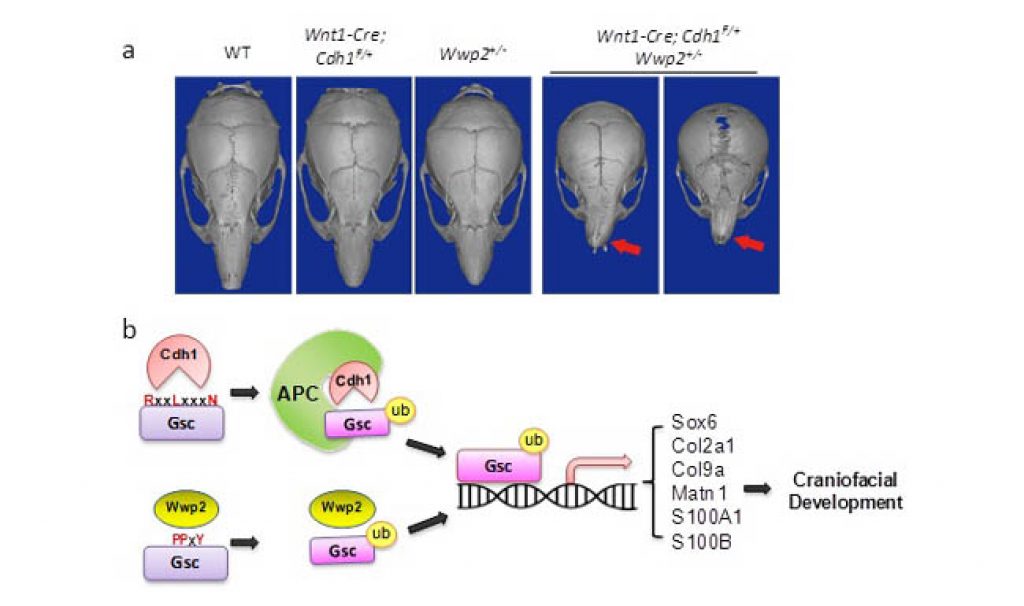
Previous studies have revealed that the Wwp2 E3 ubiquitin ligase facilitates normal craniofacial development in part through modifications such as mono-ubiquitination and the activation of the transcription factor, Goosecoid.
In the current study, led by Professor Zou Weiguo from the Shanghai Institutes for Biological Sciences, Chinese Academy of Sciences, researchers have identified that Goosecoid is also ubiquitinated and activated by a protein called APCCdh1 ubiquitin E3 ligase. This modification leads to the transcriptional activation of various Goosecoid target genes crucial for craniofacial development.
In keeping with this finding, knocking out Cdh1 specifically in the neural crest led to mice with mice bone malformations in the craniofacial region similar to that observed in Wwp2 deficient mice. The malformations were characterized by a domed skull, a short snout and a twisted nasal bone. Like Wwp2 deficient mice, mice with a Cdh1 deficiency in neural crest cells exhibit reduced Goosecoid/Sox6 transcriptional activities, suggesting the same underlying mechanism.
Simultaneous deletion of Cdh1 and Wwp2 results in a more severe craniofacial defect compared with single gene deletion, suggesting that the two genes act synergistically to orchestrate the ubiquitination of Goosecoid.
The article can be found at: Shao et al. (2016) Cdh1 Regulates Craniofacial Development via APC-Dependent Ubiquitination and Activation of Goosecoid.
———
Source: Shanghai Institutes for Biological Sciences.
Disclaimer: This article does not necessarily reflect the views of AsianScientist or its staff.