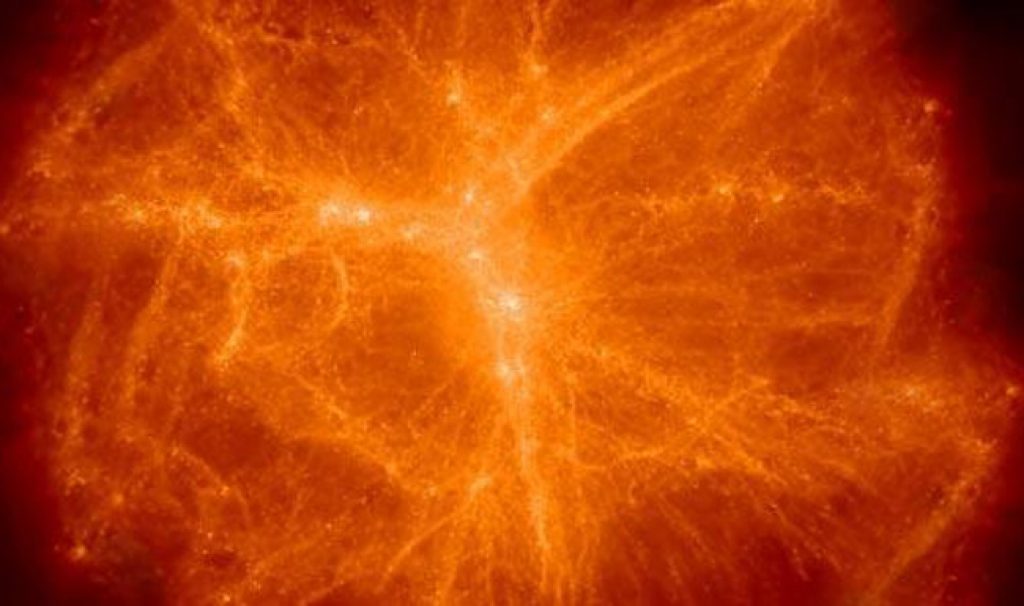
AsianScientist (Apr. 5, 2016) – Simulations by scientists in Japan and the US show for the first time exactly how supermassive black holes formed 700 million years after the Big Bang. Details of their work was published in Monthly Notices of the Royal Astronomical Society.
Supermassive black holes are more than a billion times the mass of our sun. Until recently, many researchers thought supermassive black holes were seeded by the collapse of some of the first stars. But modeling work by several groups has suggested that this process would only lead to small black holes.
The present study, led by Professor Kentaro Nagamine at Osaka University’s Department of Earth and Space Science and Professor Isaac Shlosman at the University of Kentucky, had other ideas. Their research team simulated a scenario in which supermassive black holes are seeded by clouds of gas falling into potential wells created by dark matter—the invisible matter that astronomers believe makes up 85 percent of the mass of the universe.
“The early universe was a dense, hot and uniform plasma,” said Nagamine. “As it cooled, fluctuations in the mass distribution formed seeds around which matter could gather due to gravity.”
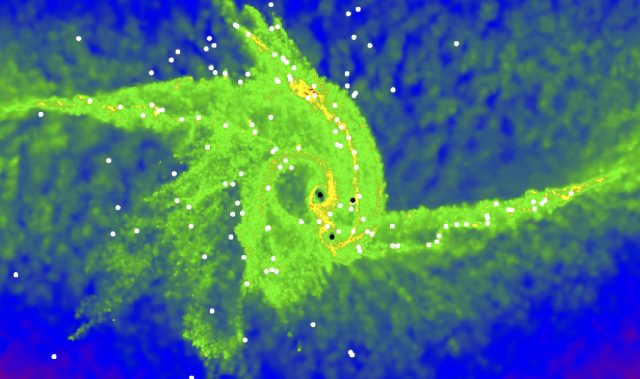
Similar processes might have later seeded the growth of bigger structures such as supermassive black holes, the authors said. However, simulating the dynamics of huge gas clouds is extremely complex, so the team had to use numerical tricks called ‘sink particles’ to simplify the problem.
“Although we have access to extremely powerful supercomputers at Osaka University’s Cybermedia Center and the National Astronomical Observatory of Japan, we can’t simulate every single gas particle,” explained Nagamine.
“Instead, we model small spatial scales using sink particles, which grow as the surrounding gas evolves. This allows us to simulate much longer timescales than was previously possible.”
The researchers found that most seed particles in their simulations did not grow very much, except for one central seed, which grew rapidly to more than two million Sun-masses in just two million years, representing a feasible path toward a supermassive black hole. Moreover, as the gas spun and collapsed around the central seed it formed two misaligned accretion disks, which have never been observed before.
The researchers hope their simulations will be validated by real data when NASA’s James Webb Space Telescope, due to be launched in 2018, observes distant sources where direct gas collapse is happening.
The article can be found at: Shlosman et al. (2016) Supermassive Black Hole Seed Formation at High Redshifts: Long-term Evolution of the Direct Collapse.
———
Source: Osaka University; Photo: Kentaro Nagamine/Osaka University.
Disclaimer: This article does not necessarily reflect the views of AsianScientist or its staff.