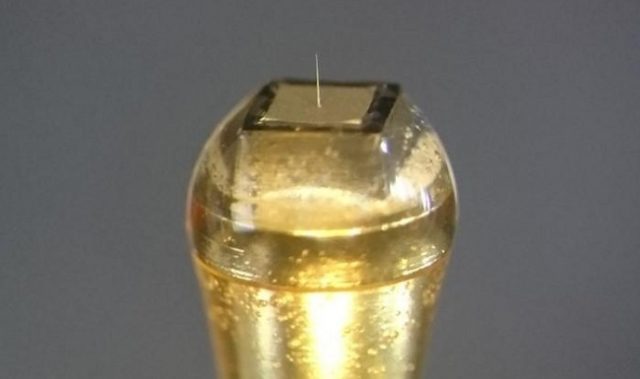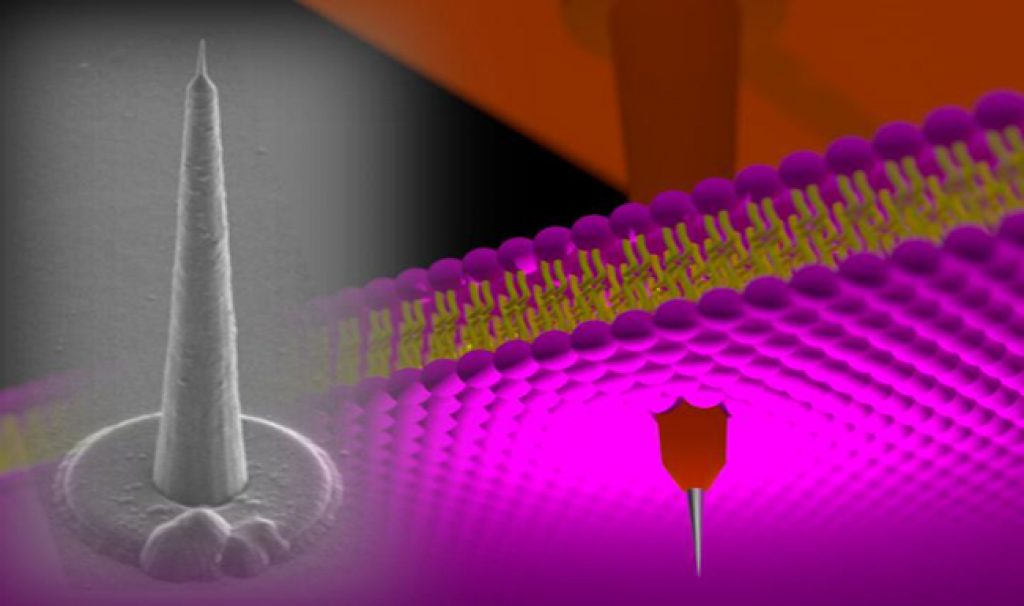
AsianScientist (Apr. 12, 2016) – A research team from Toyohashi University of Technology in Japan has developed three-dimensional microneedle-based nanoscale-tipped electrodes (NTEs) that are longer than 100 µm. The needle length exceeds that of the conventional nanowire- or nanotube-based intracellular devices, thus expanding the range of applications—such as deep tissue penetration. Additionally, they perform intracellular recordings using muscle cells. The research team’s work was published in Small.
Our current understanding of how the brain works is very poor. The electrical signals travel around the brain and throughout the body, and the electrical properties of the biological tissues are studied using electrophysiology.
Intracellular recording is a powerful method of acquiring large amplitude and high quality of neuronal signals. Nanowire- and nanotube-based devices have been developed for intracellular recording applications; however, length of these nanowire/nanotube electrode devices is currently limited to less than ten µm due to process issues that occur during fabrication of high-aspect-ratio nanoscale devices, which are more than ten µm long. Thus, conventional nanodevices are not applicable to neurons/cells within thick biological tissues, including brain slices and the brain in vivo.
“A technological challenge in electrophysiology is intracellular recordings within a thick biological tissue. For example, a needle length of more than 40 µm is necessary for performing brain slice experiments,” explained first author, PhD candidate Mr. Yoshihiro Kubota.
However, Kubota explained, it is almost impossible to penetrate nanoscale diameter needles with a high-aspect-ratio, because of the long hair-like nanostructure that has insufficient stiffness.
“On the other hand, our NTE, which is 120-µm-long cone-shaped electrode, has sufficient stiffness to punch through tissues and cells.”
According to team leader Associate Professor Takeshi Kawano, although the team has demonstrated positive preliminary results of the NTE device, batch fabrication of such intracellular electrodes, which have a needle length more than 100 µm, should lead to advancements in device technologies.
This, he said, will eventually lead to realization of multisite, depth-intracellular recordings for biological tissues, including brain slices and brain in vivo, which are beyond the capability of conventional intracellular devices; thus accelerating the understanding of the brain.
The article can be found at: Kubota et al. (2016) Nanoscale-Tipped High-Aspect-Ratio Vertical Microneedle Electrodes for Intracellular Recordings.
———
Source: Toyohashi University of Technology.
Disclaimer: This article does not necessarily reflect the views of AsianScientist or its staff.