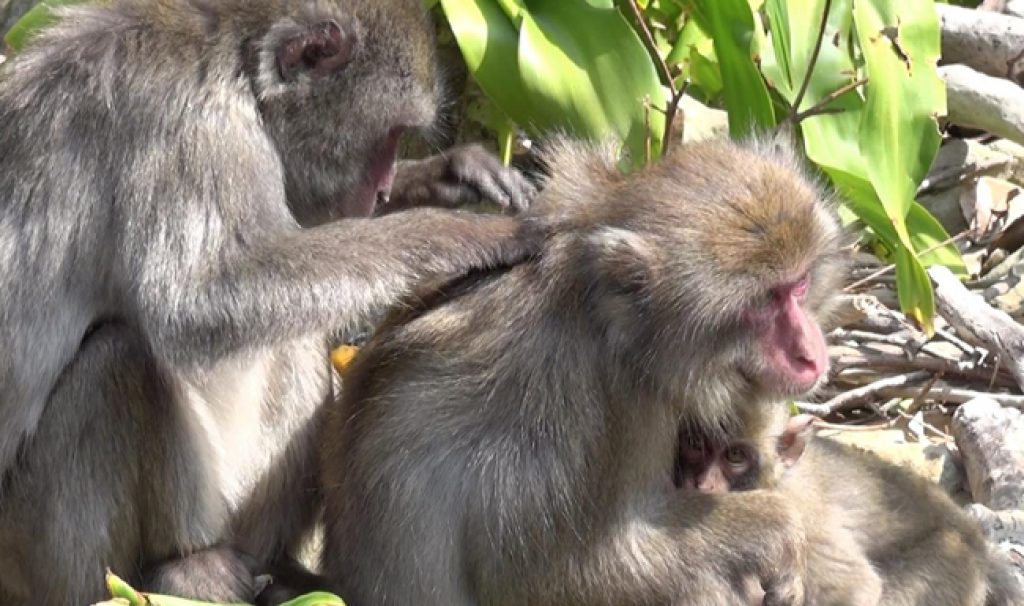
AsianScientist (Mar. 16, 2016) – Primatologists in Japan have found that female Japanese macaques at the center of their social network had less lice, thanks to the extra grooming they receive from their many friends. Their work was published in Scientific Reports.
Lice spread from person to person by direct contact. Hair combing is a preventative strategy humans use to get rid of louse eggs attached to the base of hair. Japanese macaques use a modified version of such ‘egg-picking’ while grooming each other, effectively fending off parasites.
“We thought that since grooming is one of the most common types of contact that occurs between macaques, this behavior should facilitate the transmission of lice,” said lead author Julie Duboscq.
“At the same time, grooming might also constrain the spread of lice because louse eggs are removed during grooming, which reduces future generations of lice.”
Duboscq and colleagues observed the macaques’ egg-picking behavior over 142 days to estimate the amount of lice each individual carried. They observed who was grooming whom and how often; with this information they built a model of the group’s social network, which gave them insight into which individuals are more social, or central, in the group.
The team found that central females have less lice, and that the effects were most profound during the most physically demanding times for females—namely during winter when macaques mate, and during summer when they give birth.
But that doesn’t mean that the central females always enjoy the benefits of popularity.
“The link between sociality and parasitism is not always straightforward,” said senior author Andrew MacIntosh, a researcher at Kyoto University’s Primate Research Institute.
“Increased centrality in social networks is often linked to increased parasite load and disease risk.”
The article can be found at: Duboscq et al. (2016) Network Centrality and Seasonality Interact to Predict Lice Load in a Social Primate.
———
Source: Kyoto University; Photo: Julie Duboscq/Kyoto University.
Disclaimer: This article does not necessarily reflect the views of AsianScientist or its staff.