AsianScientist (Mar. 25, 2016) – A team led by Professor Yasuhiro Yamada at the Center for iPS Cell Research and Application, Kyoto University has used induced pluripotent stem (iPS) cells to understand the role of a gene linked to bone cancers such as Ewing sarcomas. They found that the gene, called EWS-FLI1, was necessary but not sufficient to cause cancer, suggesting that it partners with other mutations to cause disease. Their findings were published in Stem Cell Reports.
Unlike normal cells, cancer cells proliferate uncontrollably, causing their spread throughout the body. This irregular proliferation is often attributed to mutant genes. iPS cell technology has given cancer researchers a tool to reprogram cells and thus allows researchers to watch the cancer develop in real time.
“We can modify the genes of iPS cells and then differentiate them to evaluate the importance of the mutation,” says Yamada. “[However,] most sarcomas are resistant to reprogramming.”
Fortunately for his lab, he discovered some sarcomas that are not. To identify the other mutations that cooperate with EWS-FLI1, the researchers inserted EWS-FLI1 into embryonic stem cells and introduced these cells into otherwise normal mice. When the mice were fed with the antibiotic doxycycline, the EWS-FLI1 gene was expressed. The mice, however, failed to develop tumors.
“This proves that other mutations are necessary,” explained Yamada.
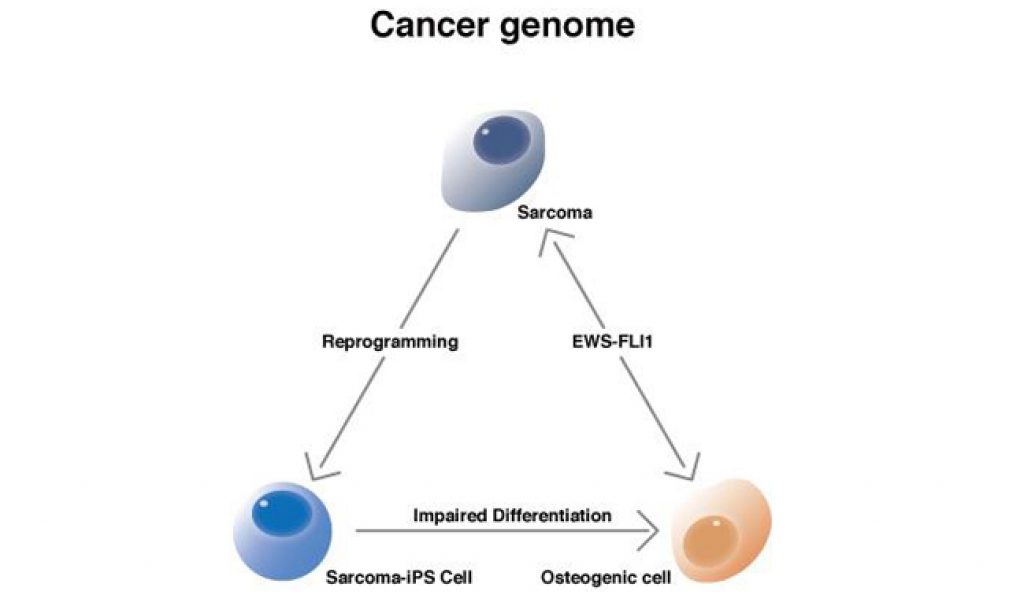
However, when random mutations were added along with the EWS-FLI1 gene, the mice grew tumors consistent of osteosarcomas, a type of bone cancer. The researchers then attempted to reprogram the tumor cells into iPS cells (sarcoma-iPS cells), succeeding in two cases.
The generation of sarcoma-iPS cells allowed the scientists to observe how the additional mutations affect cell differentiation. In sarcoma-iPS cells in which the EWS-FLI1 gene was not activated, no tumors formed although aberrant differentiation was found.
“Osteogenic cells [which go on to produce bone cells] did not develop properly,” said Yamada.
When the EWS-FLI1 gene was activated, the cells proceeded to form tumors. Yamada surmises that the unknown mutations affect the differentiation of osteogenic cells and that this mechanism is what makes the EWS-FLI1 gene oncogenic. He therefore proposes that the sarcoma-iPS cells could be valuable for drug discovery, as chemicals that correct the differentiation could prevent bone cancers from forming even in cases where the EWS-FLI1 gene is expressed.
“This platform will be helpful to find small compounds for treatment,” he said.
The article can be found at: Komura et al. (2016) An EWS-FLI1-Induced Osteosarcoma Model Unveiled a Crucial Role of Impaired Osteogenic Differentiation on Osteosarcoma Development.
———
Source: Center for iPS Cell Research and Application, Kyoto University.
Disclaimer: This article does not necessarily reflect the views of AsianScientist or its staff.