AsianScientist (Mar. 15, 2016) – The Asia Pacific region is home to more than 3.7 billion people, slightly over half the world’s population. Although extremely diverse, including countries like Singapore and Vietnam whose per capita GDP differs ten-fold, it is a healthcare market that no one can afford to ignore.
Medical technology companies, in particular, have substantial room for growth, as demand is driven up by the region’s aging population and rapidly growing spending power. In fact, Asia Pacific is poised to outgrow the European Union as the second largest market for medtech within the next five years, according to analysts from Business Monitor International.
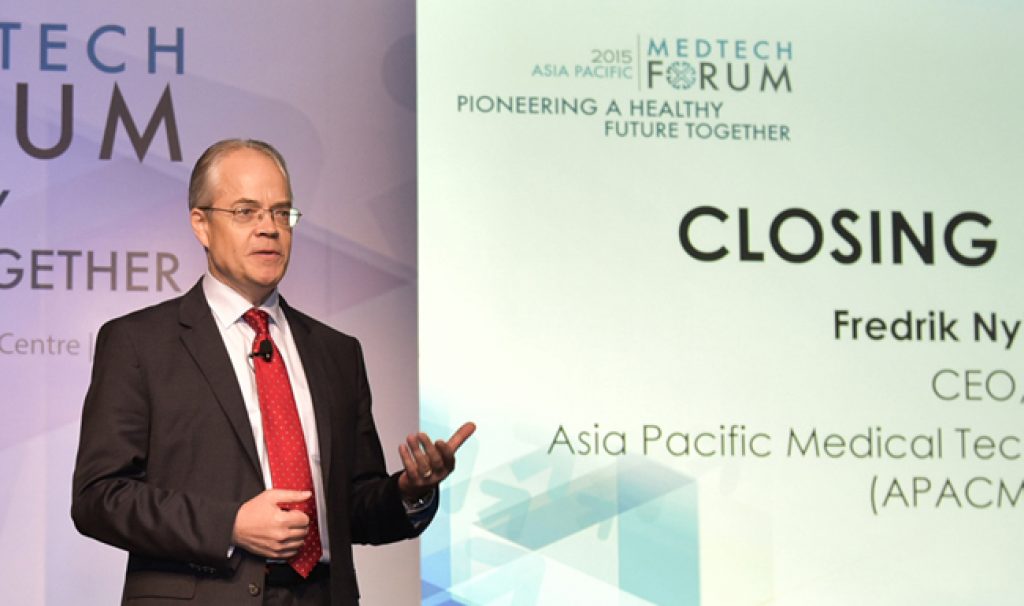
But before businesses can tap into the vast potential of the Asia Pacific medtech market, several challenges have to be overcome, CEO of Asia Pacific Medical Technology Association (APACMed), Mr. Fredrik Nyberg told Asian Scientist Magazine.
APACMed, an industry association representing companies such as Abbott, Baxter, B. Braun and GE Healthcare, was set up in April 2015 to promote medtech in the region. As part of their activities, they organized the inaugural Asia Pacific MedTech Forum in December 2015, a two day conference that brought together stakeholders, policymakers, healthcare professional, senior executives from the medical device industry.
Nyberg, who has over 30 years of experience in the medtech industry, shares with us how he hopes APACMed will help both small and large companies overcome the challenges posed by the Asia Pacific market and his insights into the industry as a whole.
- What is the goal of APACMed? What specific need is it designed to meet?
- What are the unique challenges and opportunities in Asia’s medtech sector?
- Where do you think the industry is headed in the next 5-10 years?
- Which are the markets that have the most growth potential and why?
The Asia Pacific Medical Technology Association (APACMed) was established in late 2014 with the aim of unifying the industry to raise standards of care for patients in the region. Our founding members are some of world’s largest medical devices and in vitro diagnostics manufacturers. However, we also welcome service providers and SMEs (small and medium-sized enterprises).
The diversity across Asia Pacific in demographics, disease profiles, healthcare systems, and regulatory regimes presents big challenges. Our aim is to support our member companies in addressing these challenges.
We work with our member organizations to demonstrate the value of innovation in medical technology and the benefits it brings to patients. We work on regional initiatives to promote regulatory harmonisation or convergence, ensuring that patients have timely access to new life-saving technologies. We recently launched our own Code of Ethical Conduct and we support effective industry self-regulation. We also provide a range of member services and host the annual Asia Pacific MedTech Forum conference.
Demand for quality healthcare is soaring in our region, driven by an aging population, a growing middle class, and a rising chronic disease burden. Yet, the healthcare needs of the majority of the population remain unmet. For example, hospital infrastructure build is not keeping up with demand; many countries have severe shortages of doctors, early prevention and screening varies and regulatory approval processes for new therapies and technologies are poorly harmonized across the region.
APACMed has worked closely with our knowledge partner, McKinsey & Company, to analyze the medical technology industry dynamics in Asia Pacific. The findings of the subsequent whitepaper launched at our inaugural MedTech Forum last year, identified priority areas where we can begin work as a unified industry. For example, we found the need for much greater collaboration among stakeholders to build regulatory capacity, to enhance pace and quality of medical education and to accelerate the adoption of new innovative healthcare delivery models (e.g. in homecare).
The focus of the medical technology industry in Asia is shifting to address the needs of a rapidly growing middle class with chronic, non-communicable diseases and an aging population.
In terms of global technological shifts, we are seeing convergence in areas such as nanotechnology and drug delivery; big data analytics and patient monitoring; 3D printing and personalized medicine; robotics and miniaturization; telemedicine and frugal point-of-care imaging. The benefits to patients in Asia Pacific will be enormous.
Interestingly, we are also seeing medical technology innovation shifting to emerging markets in general and to Asia in particular, with China and India are set to become the new innovation powerhouses in medical technology.
It really depends on the product segment and disease area. Broadly speaking, the three most populous countries in the region, China, India and Indonesia, will no doubt continue to drive growth across many segments. These are also markets with significant gaps in healthcare infrastructure.
Reform and the move towards universal healthcare will drive infrastructure build and long term growth. However, the challenge in many emerging markets is the shortage of trained healthcare professionals.
Asian Scientist Magazine is a media partner of Asia Pacific MedTech Forum 2015.
———
Copyright: Asian Scientist Magazine; Photo: APACMed.
Disclaimer: This article does not necessarily reflect the views of AsianScientist or its staff.