AsianScientist (Mar. 23, 2016) – When the Singapore government set out its most recent five-year Research, Innovation and Enterprise Plan (RIE2020) in January 2016, it laid down new roads over which it hoped research would travel faster and more deeply into industry.
The new spend on commercialization was significant. Of RIE2020’s S$19 billion budget, which represents an 18 percent jump from the previous five-year budget, about S$3.3 billion, or 17 percent, was devoted to innovation and enterprise.
This was notable when held against the S$3.3 billion for economic-led advanced manufacturing and engineering research, S$2.8 billion for academic research, and S$2.5 billion devoted to discovery-led, ‘white-space’ research.

A singular pursuit of innovation
Amongst the institutions in Singapore now dedicated to this aim is the Innovation Centre of SMART. The Centre funds scientists to pursue market-driven research and creates programs to accelerate the commercialization of their innovations, through advice such as intellectual property and ‘go-to-market’ strategies, and through building connections with investors, entrepreneurs and the business community.
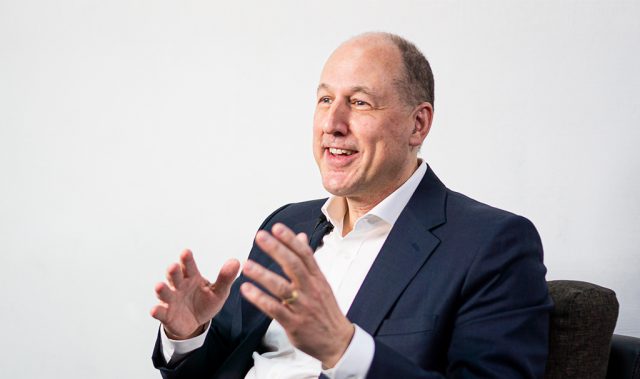
Howard Califano, director of the SMART Innovation Centre, is a first-hand witness to progress so far, having arrived in Singapore from the United States not long after Singapore launched its first national research and development plan in 1998, to head Johns Hopkins Singapore and the Johns Hopkins-National University Hospital International Medical Center. Since then, he has taken on positions such as consulting director of biomedical sciences investor Bio*One Capital, and director and CEO of multiple companies in the US and Asia.
Having observed developments over the previous five-year roadmaps, Califano believes the new phase of commercialization that began in 2011 is “progressing nicely,” pointing out that Singapore has proved it can create well-funded institutions that produce world-class research.
“The commercialization of Information communications technology (ICT) has done extremely well,” Califano notes. “While other areas like deep science and the medical space have not done quite as well; but, their momentum is beginning to change.”
The task of building a mature commercialization environment is only just getting started, he says.
“The question now is how do you develop an entire ecosystem, which can harvest and monetize these discoveries. The latest five-year phase will help institutions do this.”
Noting that the commercialization process is only five years old, Califano hopes that the next five years will see the development of an ecosystem that can mature into one with the depth of Boston, hometown to the hallowed Massachusetts Institute of Technology and its various spinoff and startup companies.
Boston’s success, he says, rests on the experienced community of people who have gone through many cycles of bringing new concepts to the market—incubators, venture capitalists and CEOs who have launched companies and who know how to bridge the gap between research centers and fully-funded companies.
In Southeast Asia’s nascent startup sector, public R&D spending on innovation and enterprise will give Singapore-based scientists stronger support to take their concepts out of the lab and into the market, he says. This support would come in the form of technology transfer offices, innovation centers and innovation incubators and accelerators.
Seeding market success
The SMART Innovation Centre works at the incubation stage of the ecosystem, but it has a determined focus on the market, says Califano.
“Ours is not an ordinary grant,” he explains. “It starts from the opposite end of the usual arc that runs from a scientist’s initial curiosity to the preference of a typical customer. A panel of 30 investors and entrepreneurs consider about 200 applications per year.
“The question the panel asks itself is, ‘Is this a project we can drive to the point where it can be a viable business?’”
In addition, the panel is agnostic as to the technology, industry and institution, says Califano, and grants they have awarded span ICT, engineering and medical technology. And instead of just providing the funding and “walking away,” the Centre helps to builds a whole support structure, starting with a three-weekend boot camp to craft a business road map where the customer needs and beachhead markets are taken into consideration, to business mentors, who train and mature the project team.
Once a group has tailored its technology to meet market needs, gained further funding such as a ‘proof of value’ grant from government agency SPRING Singapore, and perhaps found an angel investor, then a company is ready for launch—a startup is born.
“That plan has worked out pretty nicely, and now Singapore is looking at how we can establish the rest of the ecosystem,” Califano says, adding that the hard part has just begun.
“Raising the first million has become relatively easy. It is the next round—the next two to five million that is very difficult.”
Two keys to a self-sustaining ecosystem are more private commercial funding and experienced personnel to pilot the ship, according to Califano.
“Investors want to know: Who is going to execute this? Who is going to make this happen?”
Indeed, finding enough people with the experience to execute is perhaps the foremost challenge facing Singapore’s commercialization ambitions.
“If we want to increase the number of medtech [medical technology] firms in Singapore from 100 to 400, then we need an additional 300 CEOs, 300 CTOs—that is the greatest need—either training that talent locally or bringing it in from overseas.”
Califano believes the government is aware of the need to tackle this problem and nurture a more self-sustaining sector if Singapore is to see more global scale commercialization ventures.
“Clearly the government initiatives are necessary to prime the pump, to get things going and create infrastructure, but for the ecosystem to survive it requires more private investment,” he says, adding that private equity or venture capital is more commercially driven and flexible than pure government funds.
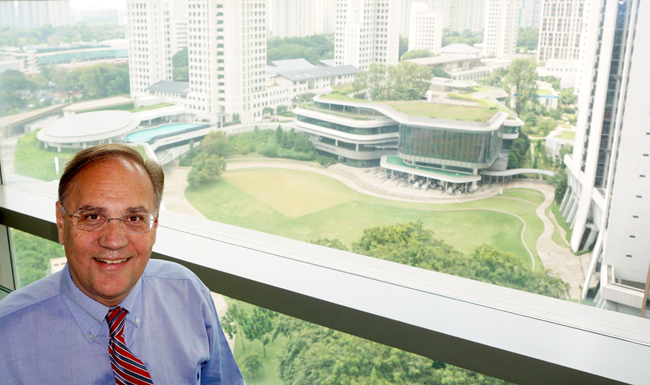
Getting private funding as well as promoting product commercialization is a “contact sport”
During the January 8 launch of the RIE2020 plan, Singapore Prime Minister Lee Hsien Loong expressed his hope to see private sector R&D spending grow from the current 1:1.5 ratio of public to private funding, to 1:1.8.
To entice the private sector, startup founders must be responsive and flexible to market needs, Califano says, because what comes out of the lab is often not quite in tune with market needs.
“Normally the projects we see have a cool technology, but are not sure what its market might be.”
Califano describes answering this question as a “contact sport”—you cannot answer it by just sitting at your office desk. Instead students and post-doctoral researchers must be willing to interview customers and refine their concept iteratively in response to market data.
His experience so far suggests that the research community is getting used to this creative tension and becoming more responsive to market needs.
“When the data does show a need to pivot the technology around what customers want, they are surprisingly willing to pivot because their desire is to see their technology address a real need.”
This process of adaptation only adds to the importance of flexibility in the funding and managing of commercialization of research, something which in the long term private funding can usually manage better than public funding.
Califano cites examples of teams that have taken new technology and responded well to the market to adapt into something the market needs and wants. A prime example is the story of Singapore firm Visenti, which develops technology for water infrastructure.
Visenti’s original technology used sensors and big data to detect leaks before they become a problem. But when they sought out industry funding and support, they found that leaks were not the utilities companies’ problem—their real need was to understand the dynamics of their own system and so make it more efficient.
“What they needed was different from what the scientists envisaged,” Califano muses.
After adapting their technology to the customer’s needs, Visenti secured a pilot project and then a multi-million dollar deal with Singapore’s Public Utilities Board.
The Visenti experience is a great example of how Singapore researchers can achieve sustainable success for their product, Califano points out.
“Singapore is a fantastic showcase customer, particularly in the area of urban sustainability and water conservation. Combined with their ability to adapt the technology, this helped Visenti to go global.”
Starting ideas
Aside from awarding grants to deserving inventors, Califano describes the Centre’s efforts to start a “culture of innovation” among Singapore’s researchers.
Last year, his team worked with IDA to launch the MIT Hacking Medicine@SG competition modeled after MIT’s long-standing MIT Hacking Medicine program. The inaugural event ran from July 25-26, 2015 under the theme “aging in place,” and called for innovative solutions to help the rapidly growing aging market.
Participating teams had 24 hours to develop multidisciplinary and innovative solutions based on the theme, produce a prototype to demonstrate their solution, and pitch their idea to the judging panel.
The top prize of S$9,000 went to CareGiver, which proposed an app to better connect seniors’ caregivers to their physicians. The second place prize of S$6,000 went to FoodNut, which leveraged smart tech to manage diabetes through a healthy and tasty diet. The inventors of Jaga.me, a platform matching elderly patients to care aides, won the third prize of S$3,000.
Califano hopes that such hackathons will grow a generation of innovators in Singapore.
“The goal is to gather a diverse group of stakeholders—doctors, nurses, engineers, programmers and business types—to deconstruct big healthcare problems and reconstruct novel solutions,” he shares.
Overall, Califano feels that the Singapore National Research Foundation, through the CREATE (Campus for Research Excellence and Technological Enterprise) programme, has indelibly set a strong foundation for R&D to take off.
“Without their foresight and strong support, our pipeline of spinoffs which have taken flight, would not have been possible.”
———
Copyright: Asian Scientist; Photo: SMART.
Disclaimer: This article does not necessarily reflect the views of AsianScientist or its staff.