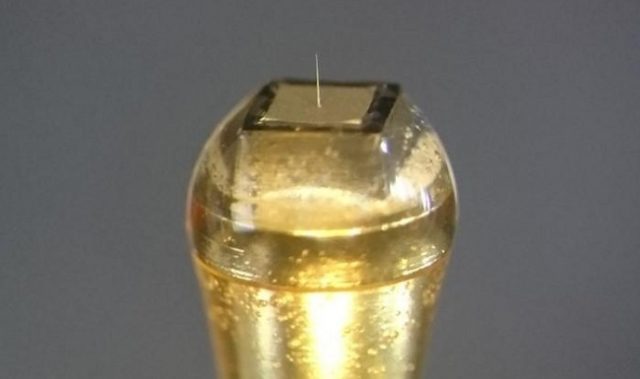
AsianScientist (Dec. 15, 2015) – Researchers have developed a new gene-transfection method with sufficient transfection efficiency and cell viability: water-in-oil (W/O) droplet electroporation. The finding, published in PLOS ONE, shows that when a liquid droplet suspended between a pair of electrodes in dielectric oil is exposed to a direct current (DC) electric fields, the droplet moves between the pair of electrodes periodically and deforms under the intense DC electric field.
The research was carried out at the Department of Environmental and Life Sciences and Electronics-Inspired Interdisciplinary Research Institute (EIIRIS) in the Toyohashi University of Technology.
Living cells use complex mechanisms to express genes involved in physiological functions, like development and metabolism. The cell membrane protects the genome from various exogenous molecules. Cell transfection is a fundamental technique that is used to deliver molecules, such as nucleic acids, proteins, and drugs, into living cells. The technique has been implicated in the development of a broad spectrum of life science applications.
Electroporation is a popular technique for the delivery of cell-impermeable molecules into cells through transient pores in the cell membrane, which are formed by exposing cells to electric pulses. However, most commercial electroporation-based transfection methods require the use of specialized pulse generators to produce short electrical pulses at high voltage.
The first authors, Assistant Professor Hirofumi Kurita and Professor Akio Mizuno, said, “W/O droplet electroporation is operated using a DC power supply, which obviates the need for an expensive pulse generator. In addition, the size of the droplet is quite small compared with that in conventional bulk electroporation, resulting in the use of fewer materials in high-throughput analysis.”
Associate Professor Rika Numano explained, “The W/O droplet electroporation technique has several advantages over conventional transfection techniques: small cell number required, as low as 1,000 cells; small amount of DNA required, which makes it applicable for various cell types including neural cells; and changeable genome DNA.”
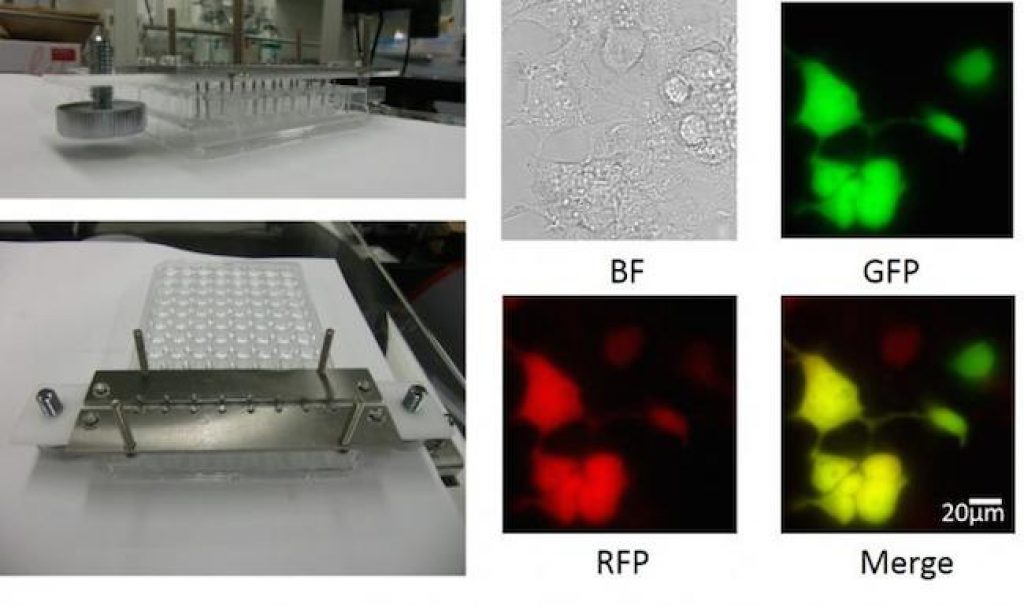
The researchers said that there have been improvements in W/O-droplet electroporation electrodes for use in disposable 96-well plates for concurrent performance. The W/O droplet electroporation technique can contribute to further biomedical innovation in high-throughput screening with a large number of samples for applications in regenerative medicine and gene therapy.
The article can be found at: Kurita et al. (2015) Novel Parallelized Electroporation by Electrostatic Manipulation of a Water-in-Oil Droplet as a Microreactor.
———
Source: Toyohashi University of Technology.
Disclaimer: This article does not necessarily reflect the views of AsianScientist or its staff.