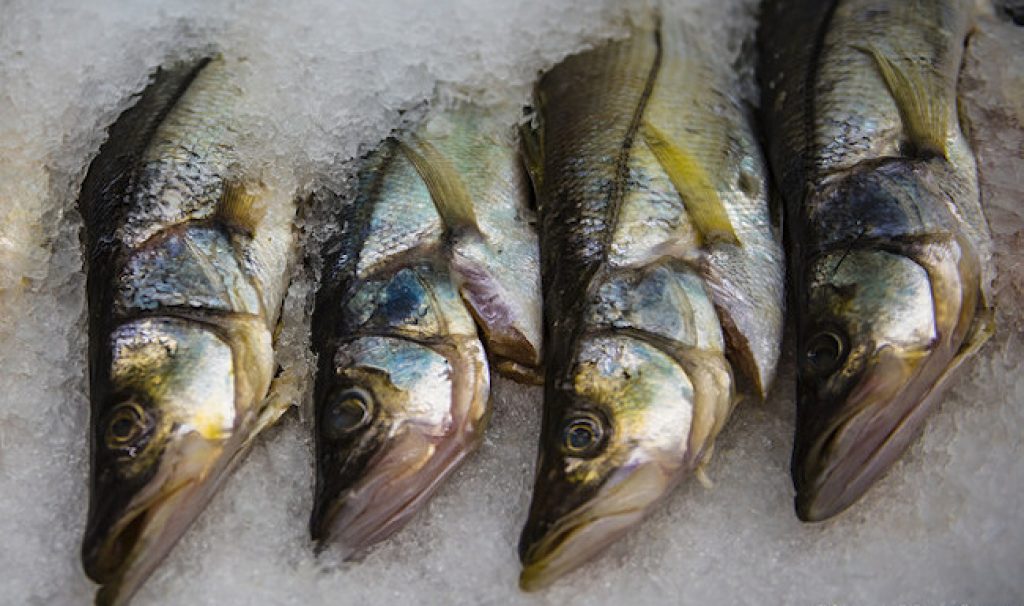
AsianScientist (Dec. 9, 2015) – Scientists are developing a faster way to test how fresh fish was before it was frozen. Their method, described in Food Science & Nutrition, makes use of fluorescent-emitting molecules found naturally in meat.
In Japan, the freshness of fish is crucial because of the popularity of raw dishes such as sashimi and sushi. Yet it is very difficult to estimate the freshness of frozen seafood products. Current methods to determine the freshness of fish calculate K-values based on chemical assays of nucleotides, but this is very time consuming, taking at least one or two days of intensive laboratory work.
Dr. Gamal ElMasry, the first author of the study, and a Japan Society for the Promotion of Science fellow from Egypt, explained that fluorescence signals from frozen fish change dramatically depending on their initial condition before being frozen. The changes that occur in the fluorescent-emitting molecules as the fish degrades can be tracked using their fluorescence signals.
“Autofluorescence spectroscopy is an interesting sensor technology characterized by high sensitivity and accuracy, and so is a substantial and promising tool in the screening of fishery products even in their frozen state,” said ElMasry.
The research team is working on the first steps of developing such a system by analyzing excitation-emission matrices (EEMS) of frozen fish of different stages of freshness and measuring their reference freshness values by using high-pressure liquid chromatography (HPLC).
“We have found that there are some specific excitation wavelengths at which the detection of freshness of frozen fish could be easily recognized. The problem is to identify the most efficient emission wavelengths to move the application forward towards the real-time mode for on-line applications”, explained study co-author Shigeki Nakauchi, a professor at the Toyohashi University of Technology.
The article can be found at: ElMasry et al. (2015) Approximation of Meat Spectral Patterns in the Short-Wave Infrared Region Based on the Major Chemical Composition.
———
Source: Toyohasi University of Technology; Photo: Marc Cooper/Flickr/CC.
Disclaimer: This article does not necessarily reflect the views of AsianScientist or its staff.