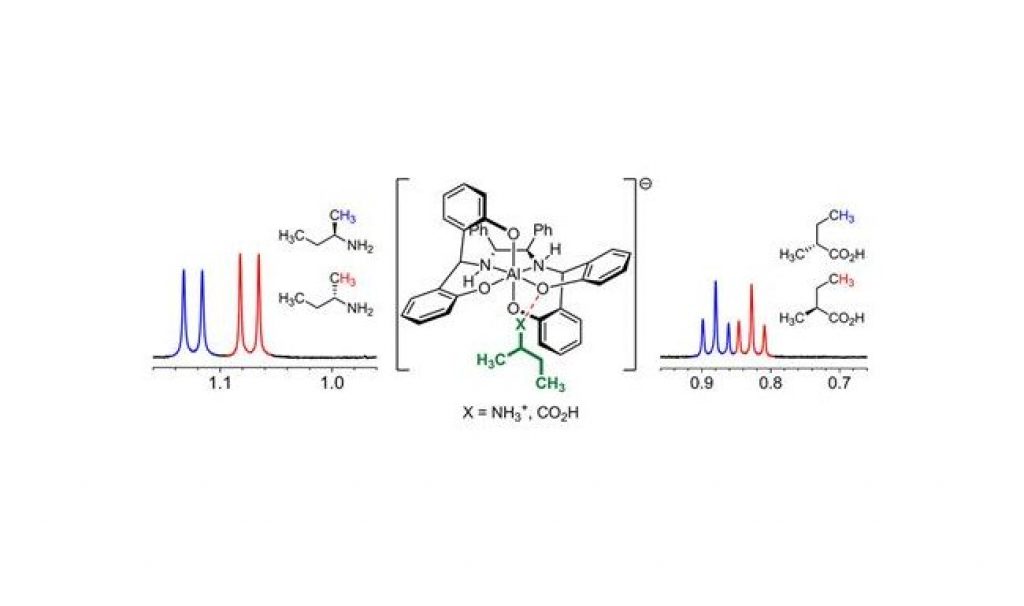
AsianScientist (Dec. 4, 2015) – Scientists have found a way to easily analyze charged compounds’ optical activity by using nuclear magnetic resonance (NMR) spectroscopy. The finding, published in The Journal of the American Chemical Society, may make it faster and cheaper for labs to analyze optical activity when developing new medicine.
The technique, developed by Professor Kim Hyunwoo of the Korea Advanced Institute of Science and Technology (KAIST), relies on observation of the behavior of optical isomers. Molecules with the same composition that are mirror images of each other are optical isomers. For example, the building blocks of all living organisms, amino acids, are a single optical isomer. In our bodies, optical isomers bring different physiological changes due to their distinct optical activities. Therefore, controlling and analyzing the optical activities are critical when developing a new drug.
High-performance liquid chromatography (HPLC) is the de facto standard of analyzing the optical activity of a compound. However, HPLC is very expensive and slow; one analysis may take 30 minutes to one hour to complete. Furthermore, it lacks signal sensitivity and chemical decomposition, and the application is limited to nonpolar compounds.
Usually adopted in analyzing the structure of a chemical compound, NMR spectroscopy requires only one to five minutes per single analysis. Since it is essential for analyzing the molecular structure, many chemistry labs have NMR equipment. However, until the present study, researchers had not found an effective way of using the NMR spectroscopy to decompose the signal of chiral activity of a compound.
Kim’s technique employs negatively-charged metal compounds which bond ionically to positively- and negatively-charged optical compounds. As a result, the NMR spectroscopy can distinguish the signal from chiral activity. Not only can it analyze various chemicals without structural constraints, but it can also be used for both nonpolar and polar solvents.
As many compounds for new drugs have functional groups, which can be charged, this analysis method can be directly employed in the development process of drugs.
Kim said, “A revolutionary analysis method has been developed using simple chemical principles. I hope that our method will be applied to the development of new medicine.”
The article can be found at: Seo and Kim (2015) 1H NMR Chiral Analysis of Charged Molecules via Ion Pairing with Aluminum Complexes.
———
Source: KAIST.
Disclaimer: This article does not necessarily reflect the views of AsianScientist or its staff.