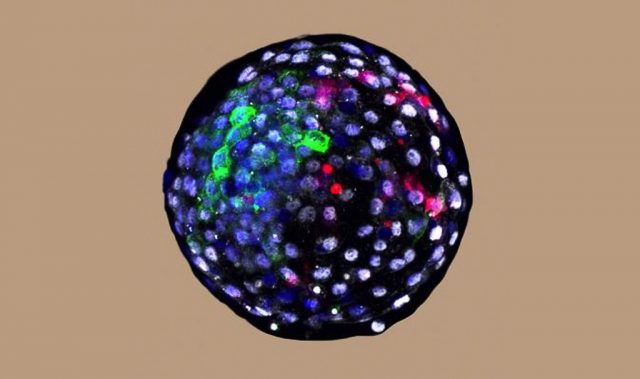
AsianScientist (Nov. 13, 2015) – Scientists have developed a 3D printing method capable of producing highly uniform ‘blocks’ of embryonic stem cells. These cells—capable of generating all cell types in the body—could be used as the ‘Lego bricks’ to build tissue constructs, larger structures of tissues, and potentially even micro-organs. The results are published in the journal Biofabrication.
The researchers, based at Tsinghua University and Drexel University used extrusion-based 3D printing to produce a grid-like 3D structure to grow embryoid body that demonstrated cell viability and rapid self-renewal for seven days while maintaining high pluripotentcy.
“We could grow embryoid body in a controlled manner”, explains Professor Sun Wei, a lead author of the paper. “The grown embryoid body is uniform and homogenous, and serves as a much better starting point for further tissue growth.”
“Two other common methods of printing these cells are either two-dimensional (in a petri dish) or via the ‘suspension’ method (where a ‘stalagmite’ of cells is built up by material being dropped via gravity),” continues Sun. “However, these don’t show the same cell uniformity and homogenous proliferation.”
“I think that we’ve produced a 3-D microenvironment which is much more like that found in vivo for growing embryoid body, which explains the higher levels of cell proliferation.”
The researchers hope that this technique can be developed to produce embryoid body at a high throughput, providing the basic building blocks for other researchers to perform experiments on tissue regeneration and/or for drug screening studies.
“Our next step is to find out more about how we can vary the size of the embryoid body by changing the printing and structural parameters, and how varying the embryoid body size leads to “manufacture” of different cell types,” added Professor Yao Rui, another author of the paper.
“In the longer term, we’d like to produce controlled heterogeneous embryonic bodies,” concludes Sun. “This would promote different cell types developing next to each other—which would lead the way for growing micro-organs from scratch within the lab.”
The article can be found at: Ouyang et al. (2015) Three-Dimensional Bioprinting of Embryonic Stem Cells Directs Highly Uniform Embryoid Body Formation.
———
Source: Institute of Physics; Photo: Shutterstock.
Disclaimer: This article does not necessarily reflect the views of AsianScientist or its staff.