AsianScientist (Oct. 19, 2015) – Researchers from Xishuangbanna Tropical Botanical Garden (XTBG) have found that nestlings only defecate shortly after feeding to keep the nest clean. Their work has been published in Frontiers in Zoology.
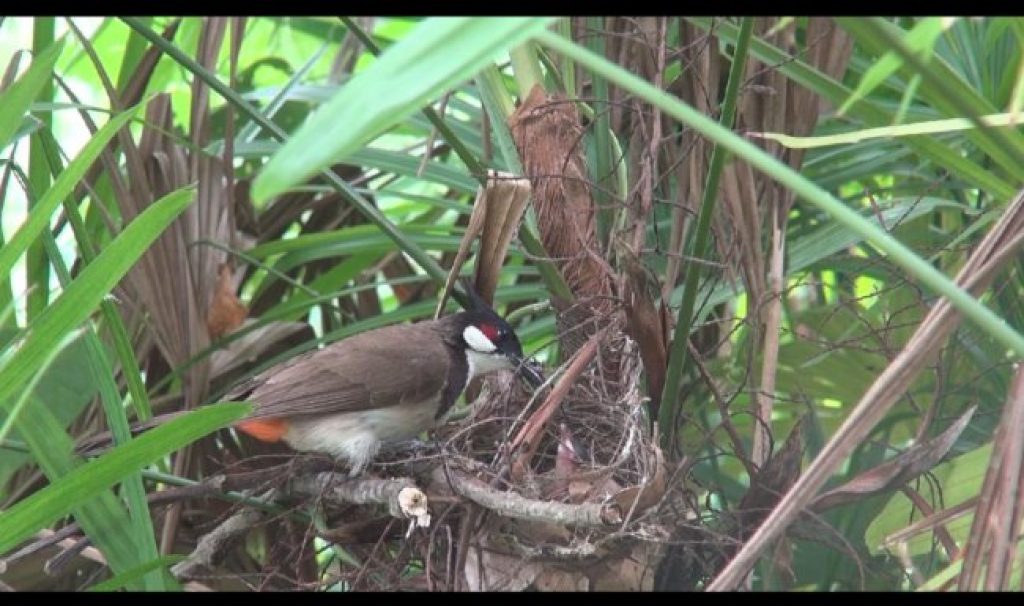
The team studied the common passerine bird species of Southwestern China to find out what was the right time of defecation by nestlings and what mechanism guaranteed all of the defecation to occur at the right time. They conducted detailed observations on five nests of the Red-whiskered Bulbul (Pycnonotus jocosus) in Xishuangbanna, using a digital video camera.
Adult birds clean the nest by consuming or transporting feces, which is thought to be important in order to lower the levels of parasites, pathogens and predation at the nest. Previous research has anecdotally noted that defecation often follows feeding, but has not quantitatively analyzed the timing and factors eliciting defecation.
The field nest survey, conducted by Professor Quan Ruichang and his team, has showed that no excreta remained in nests at any time of the nestling period, suggesting that all feces were immediately disposed of after defection.
Their findings indicate that feces were excreted at the hypothesized ‘right time,’ the time following feeding that enabled feces to be disposed immediately. According to the data collected at the five videotaped nests, the timing of the next defecation was not predictable based on the period between the last two defecations.
As nestlings do not defecate if there were no feeding, it strongly suggests that feeding was the stimulus that released defecation. The parents’ presence near the nestlings was not enough to stimulate defecation.
The laboratory experiment showed that nestlings’ excreting time was very plastic as nestlings can wait for at least two hours to defecate. In addition, nestlings produced heavier fecal sacs associated with the longer feeding intervals. The results showed that there was a parent-nestling coordination system that parents provided the feeding, but at the same time the nestlings were able to modify their physiological process to wait for the parents to come and feed.
Their study also showed that if excrement occurred at the wrong time–when parents were absent–both nestlings and parents could bear possible negative consequences, such as less feeding for nestlings, less rest for adults and threats of pathogens, parasites and predators.
The researchers concluded that the strong plasticity in the timing of defecation and the possibility of negative repercussions (if defecation occurred when parents were absent) were important mechanisms underlying the efficiency of the feeding-defecation system.
The article can be found at: Quan et al. (2015) The Relationship Between Defecation and Feeding in Nestling Birds: Observational and Experimental Evidence.
———
Source: Chinese Academy of Sciences.
Disclaimer: This article does not necessarily reflect the views of AsianScientist or its staff.