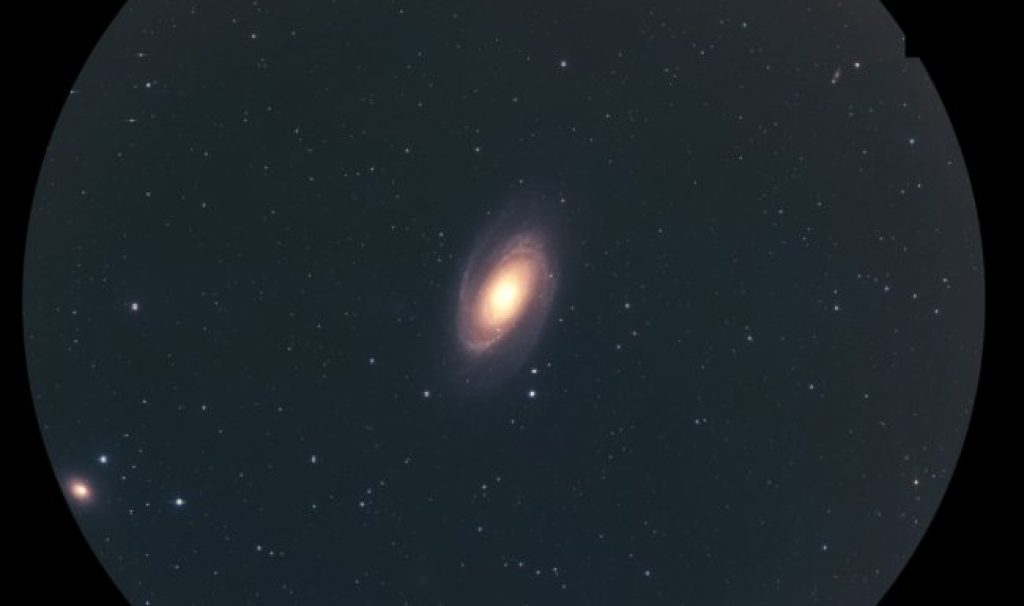
AsianScientist (Aug. 20, 2015) – Astronomers have recently observed the nearby large spiral galaxy M81, together with its two brightest neighbors, M82 and NGC3077. The results of their observations, published in The Astrophysical Journal Letters, are deep, super wide-field images of the galaxies and their populations of young stars.
“This is the first endeavor beyond the Local Group of galaxies to demonstrate the hierarchical galaxy assembly process on galactic scales,” said Dr. Sakurako Okamoto from Shanghai Astronomical Observatory, first author of the paper.
Cosmological archaeological studies such as this one help astronomers refine their understanding of galaxy formation and evolution. The currently favored cosmological galaxy models are based on the idea of hierarchical structure formation: that structures in the universe such as galaxies develop from small ‘overdensities’ to become large-scale objects.
For example, the Milky Way and M81 first formed as part of a local over-density in the primordial matter distribution—that is, the earliest accumulations of matter in the young universe. They grew over time via the agglomeration of numerous smaller building blocks, some of which may have survived later mergers to become present-day dwarf satellite galaxies.
Establishing the presence and nature of these satellites, and determining the large-scale structure and stellar content of halos in spiral galaxies, is essential to understand and explain the physics of hierarchical galaxy assembly.
Over the last decade, astronomers doing large photometric surveys (that is, measuring the light intensities of celestial objects) have found a number of new satellite galaxies, stellar streams and over-densities around the Milky Way and the Andromeda galaxies. The detailed properties of stars in these systems are studied to reconstruct the stellar contents of galaxies in the early stage, in a field called ‘galactic archeology’ or near-field cosmology.
Until now, the outskirts of the Milky Way and Andromeda are the only places that have been surveyed to sufficient faint depths to enable detailed tests of hierarchical galaxy assembly process across wide scales.
The observing team studied the M81 galactic archeology using the Hyper Suprime-Cam (HSC) of the Subaru Telescope. M81, also known as Bode’s Galaxy, is located at a distance of 11.7 million light-years, and is one of the nearest massive spiral galaxies similar to the Milky Way. The super-wide field of view of the HSC allowed the team to observe out to a projected radius of a half-million light-years from the center of M81.
The field includes 18 known member galaxies of the M81 group in only seven pointings. The camera’s high sensitivity enabled the team to observe vast numbers of old red giant branch stars as well as young main-sequence stars, red supergiants, and asymptotic giant-branch stars at the distance of M81.
“Our deep panoramic view of the M81 group demonstrates that the complexity long known to be present in neutral hydrogen is equally matched in the low surface brightness stellar component,” said Okamoto.
“Together with the Galactic Archeology study based on the HSC wide-field survey of the Subaru Strategic Program, we hope to establish the presence and nature of satellite galaxies, and determine the large-scale structure and stellar content of halos of spiral galaxies in general.”
The article can be found at: Okamoto et al. (2015) A Hyper Superime-Cam View of the Interacting Galaxies of the M81 Group.
———
Source: National Astronomical Observatory of Japan.
Disclaimer: This article does not necessarily reflect the views of AsianScientist or its staff.