AsianScientist (Aug. 11, 2015) – Simulations reveal that disk instability might be sufficient to drive the formation of both the primary and secondary bars in double-barred galaxies. These results have been published in The Astrophysical Journal.
The Milky Way Galaxy—where Earth is located—is not just a spiral galaxy, but a barred spiral. About two thirds of the known spiral galaxies are classified as barred spirals, out of which one fourth are have two bars (S2B).
The two bars of a S2B, with different sizes, rotate independently and interact with each other. Dynamically decoupled secondary bars in S2Bs have been hypothesized to be a mechanism for driving gas toward the center of galaxy to feed the supermassive black hole lurking there.
Astronomers still don’t understand how spiral galaxies get two bars. Some previous theories require the existence of gas for forming and decoupling the secondary bar. This view is not, however, universally accepted and some recent works have produced secondary bars without the direct effect from gas.
A PhD student, Du Min, working under the supervision of Professor Shen Juntai at Shanghai Astronomical Observatory (SHAO), Chinese Academy of Sciences, and Professor Victor P. Debattista from the University of Central Lancashire, has demonstrated a new approach for generating secondary bars.
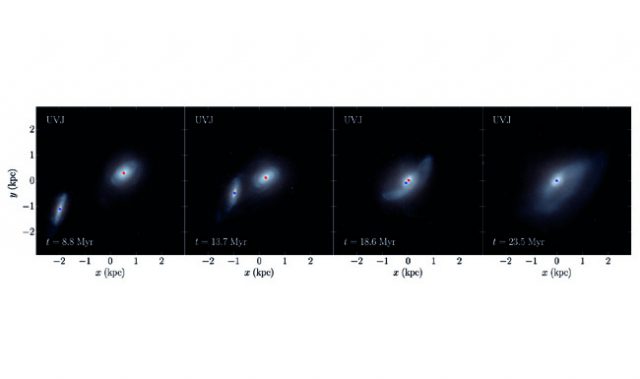
By exploring a large parameter space of isolated pure-disk simulations, Du showed that a dynamically cool inner disk embedded in a hotter outer disk can naturally generate a steady secondary bar while the outer disk forms a large-scale primary bar.
“Our method has not considered the direct effect from gas, showing that the secondary bar can be formed from pure disk instabilities,” said Du. “Such simple and natural forming conditions imply that small-scale secondary bar should be lurking in barred galaxies, even though we have not observed such ‘tiny’ structures at high redshift because of the smaller sizes.”
But how would these ‘tiny’ structures grow? There are several possible explainations.
“Some may grow longer and larger by accreting matter and finally being transformed from S2Bs to commonly observed single bar spiral galaxies,” explained Shen. “It is possible that through interactions, the secondary bar would be captured by the primary bar and finally coupled together. In all, only a few S2Bs are stable until now.”
It is generally thought that gas is driven from outside in (a possible channel is provided by the primary bar), with accumulation of gas giving rise to a cool disk that may be able to form a nuclear bar.
“With this work we have now demonstrated another method for forming double-barred galaxies without needing to resort to gas. The S2B phenomenon therefore is a phenomenon that requires the stars in the inner galaxy to be rotating differently from those further out,” said Debattista.
“In our alternative formation scenario, the secondary bar may form from the violent clumpy phase in the early universe when the primary bar is still not formed,” Shen added. “In many numerical simulations, these clumpy-origin small-scale bars could be easily mistaken as bulges.”
“Therefore, the question remains whether the small-scale bar instabilities happens at the early time of the galaxy formation or after the formation of the primary bar. To better understand the formation of S2Bs, further simulations are required.”
The article can be found at: Du et al. (2015) Forming Double-barred Galaxies from Dynamically Cool Inner Disks.
———
Source: Chinese Academy of Sciences.
Disclaimer: This article does not necessarily reflect the views of AsianScientist or its staff.