AsianScientist (Jul. 23, 2015) – Researchers have successfully developed ultrathin, all-inorganic nanowires. Their results, published in Nature Communications, pave the way for wire-based catalysts.
Nanowires are wired-shaped materials with diameters that are tens of nanometers or less. There are many types of nanowires, including semiconducting composite nanowires, metal oxide composite nanowires, and organic polymer nanowires, and they are typically used in functional materials and devices used as sensors, transistors, semiconductors, photonics devices, and solar cells.
Molecular wires composed of only inorganic materials have attracted significant attention due to their stable structures, tunable chemical compositions, and tunable properties. However, there have only been a few reports regarding the development of all-inorganic molecular nanowires.
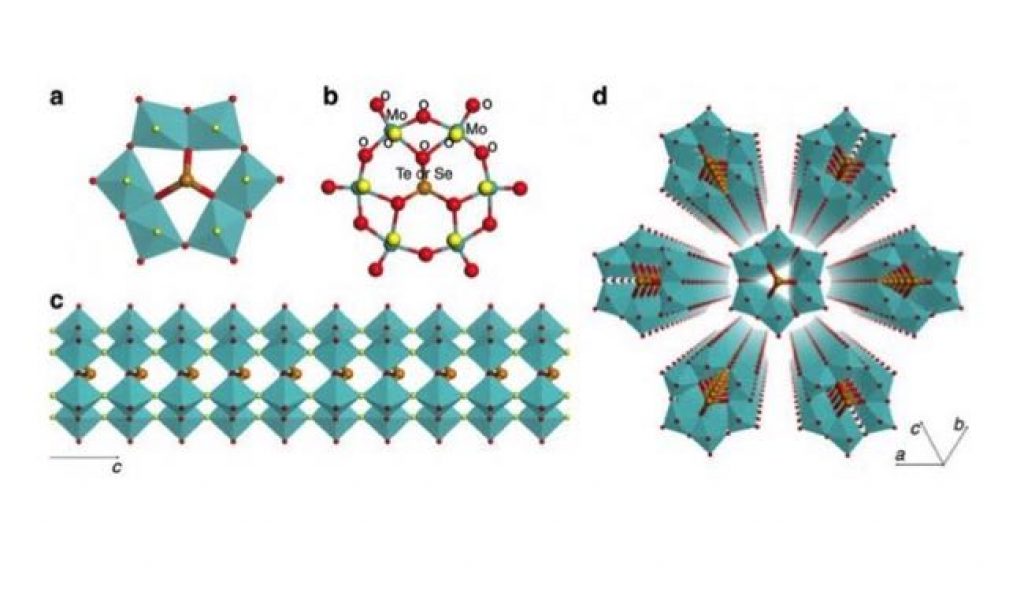
Dr. Zhenxin Zhang and Professor Wataru Ueda at the Catalysis Research Center at Hokkaido University and their collaborators at Hokkaido University, Hiroshima University, and Japan Synchrotron Radiation Research Institute/SPring-8 successfully created ultrathin all-inorganic molecular nanowires with a diameter of just 1.2 nm, composed of a repeating hexagonal molecular unit made of Molybdenum (Mo) and Tellurium (Te). These nanowires were obtained by the disassembly of the corresponding crystals through cation exchange and subsequent ultrasound treatment.
Furthermore, the researchers have shown that the ultrathin molecular wire-based material exhibits high activity as an acid catalyst, and the band gap of the molecular wire-based crystal is easily tuned via heat treatment. It is expected that the metal oxide molecular wire-based materials will open up new fields of research in heterogeneous catalysts, thermochromic materials, and semiconductors, as well as other related fields.
“This is a very rare isolated molecular nanowire based on transition metal-oxygen octahedra, and is an attractive catalyst due to the large surface area,” said Professor Masahiro Sadakane, a coauthor of this study, from Hiroshima University.
The article can be found at: Zhang et al. (2015) Ultrathin Inorganic Molecular Nanowire Based on Polyoxometalates.
—–
Source: Hiroshima University.
Disclaimer: This article does not necessarily reflect the views of AsianScientist or its staff.