AsianScientist (Jul. 16, 2015) – Researchers have developed a method of identifying and counting subspecies of bees from a pooled sample, facilitating urgently needed large scale monitoring programs. Their results, published in Methods in Ecology and Evolution, would allow conservationists to detect where and when bee species are being lost, and importantly, whether conservation interventions are making effect.
Wild bees play a key role in pollinating wild plants and cultivated crops, maintaining both biodiversity and food production. They are, however, threatened by habitat loss, pesticides, climate change and disease. Safeguarding wild bee populations and their pollination services is therefore a top priority.
Traditional monitoring involves pinning individual bees and identifying them under a microscope. But the number of bees needed to track populations reliably over the whole country makes traditional methods infeasible. Furthermore, manual identification is labor-intensive, error prone and extremely slow, meaning that the resulting data might not be available until years after the collections.
Instead, scientists led by Dr. Zhou Xin from the China National Genebank (CNGB), BGI-Shenzhen turned to mitochondrial DNA. Mitogenomes are expanded DNA markers beyond the conventional DNA barcodes, providing greater than twenty times more informative references for species diagnosis.
Firstly, the researchers sequenced the mitochondrial genomes of 48 reference species of bees in the UK. They then shotgun-sequenced the total DNA extracted from a ‘bee soup’ of over 200 individual bees collected in a trap, and compared the DNA to the reference genomes.
The process did not require taxonomic experts and had a 93.7 percent detection rate. Also, by skipping the DNA-amplification step known as PCR, the method was able to estimate the biomass contributed by each species, which makes it applicable to tracking population trajectories.
“We’re trying to speed up ecological investigation on a monumental scale,” said the lead researchers.
The article can be found at: Tang et al. (2015) High-Throughput Monitoring of Wild Bee Diversity and Abundance via Mitogenomics.
———
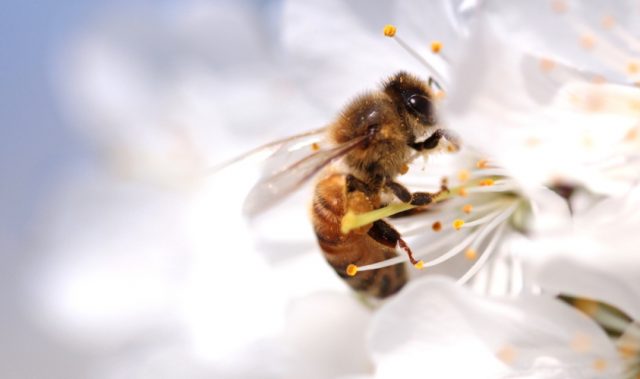
Source: BGI; Photo: Andrew Malone/Flickr/CC.
Disclaimer: This article does not necessarily reflect the views of AsianScientist or its staff.