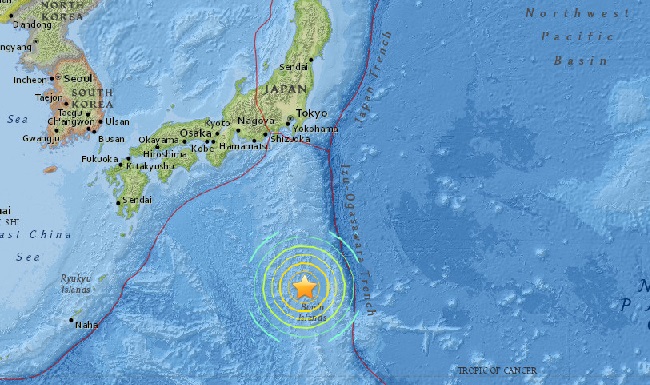
AsianScientist (Apr. 1, 2015) – Buildings destroyed by the 2011 Tohoku earthquake released thousands of tons of climate-warming and ozone-depleting chemicals into the atmosphere, according to a study published in Geophysical Research Letters.
The research suggests that the thousands of buildings destroyed and damaged during the 9.0 magnitude earthquake and tsunami that struck Japan four years ago released 6,600 metric tons (7,275 US tons) of gases stored in insulation, appliances and other equipment into the atmosphere. Emissions of these chemicals, called halocarbons, increased by 21 percent to 91 percent over typical levels.
“What we found is a new mechanism of halocarbon emissions coming from the earthquake,” said Takuya Saito, a senior researcher at the National Institute for Environmental Studies in Tsukuba and lead author of the new paper.
Saito and his colleagues decided to investigate halocarbon emissions and their relationship to the earthquake after ground-based air monitoring stations in Japan recorded surprisingly high levels of these chemicals.
The study’s authors combined these measurements with an atmospheric model and other mathematical methods to figure out that increased emissions from the earthquake were involved, how much of the emissions could be attributed to the disaster and how they compared to previous years.
About 50 percent of the halocarbon emissions after the earthquake were of HCFC-22, likely due to damage to refrigerators and air conditioners. Emissions of the gas were 38 percent higher than the years before and after the earthquake.
Emissions of CFC-11 were 72 percent higher than emissions before and after the earthquake, likely due to damage to insulation foams used in appliances and buildings. Emissions of two types of HFCs—HFC-134a and HFC-32—rose by 49 percent and 63 percent compared to the years before and after the disaster.
Halocarbon emissions from Japan in 2011 are equivalent to the discharge of 1,300 metric tons (1,433 US tons) of CFC-11 alone—equal to the amount of CFC-11s found in 2.9 million refrigerators manufactured before the chemical was banned.
The new study also calculated the total impact of the increased emissions on ozone depletion and global warming. The earthquake-triggered surge of halocarbons increased ozone loss from Japanese emissions of those six gases by 38 percent from March 2011 to February 2012 compared to the same time period in the years before and after the event. The amount of heat trapped in the atmosphere because of Japan’s emissions of those six gases rose 36 percent from March 2011 to February 2012 compared to earlier and later years because of the extra emissions from the earthquake.
Saito said the new study shows the importance of including the release of gases from natural disasters in emissions estimates. Although the global effect of one event is small—emissions associated with the Tohoku earthquake accounted for four percent or less of global emissions in 2011—the cumulative effect could be larger, he said.
National halocarbon emissions estimates by the Japanese government did not factor in the release of the chemicals due to the earthquake and are likely underestimating the amount of these substances in the atmosphere, according to Saito. Governments rely on inventories of chemicals and generic data about how they are used to estimate their amounts in the atmosphere whereas the new study uses actual measurements of the gases.
“It is apparent that there are unreported emissions,” Saito said.
The article can be found at: Saito et al. (2015) Extraordinary Halocarbon Emissions Initiated by the 2011 Tohoku Earthquake.
———
Source: American Geophysical Union.
Disclaimer: This article does not necessarily reflect the views of AsianScientist or its staff.