AsianScientist (Feb. 24, 2015) – A study published in the Journal of Colloid and Interface Science has examined the factors influencing the formation of non-spherical shapes by releasing droplets of molten wax into a cool liquid bath. The physics behind this research shows how a range of non-spherical shapes can be produced and replicated with many possible industrial applications.
Non-spherical particles have a great deal of potential uses in industry because associated with their different shapes are properties such as large surface areas, high packing densities and unique responses to external electric and magnetic fields. Such properties can lend themselves to applications ranging from food processing, consumer goods such as cosmetics, absorbents, and drug delivery systems.
Prior research in creating non-spherical particles ranging from the micron to millimeters length scale has yielded production methods that are limited in scope and usually require the use of specialized equipment. Instead, Okinawa Institute of Science and Technology Graduate University (OIST) Professor Amy Shen developed a simple, low cost, scalable method that is applicable to many types of fluids.
In collaboration with her former student Shilpa Beesabathuni from University of Washington, as well as The Procter & Gamble Company, Shen tested the formation of non-spherical particles by forming molten liquid drops and releasing them into a bath of cooler liquid to solidify them.
In order to explore what shapes were possible, many different variables had to be taken into account, such as the temperature of the wax, temperature of the liquid bath, density and viscosity of the liquid bath, and the impact speed of the molten liquid drop.
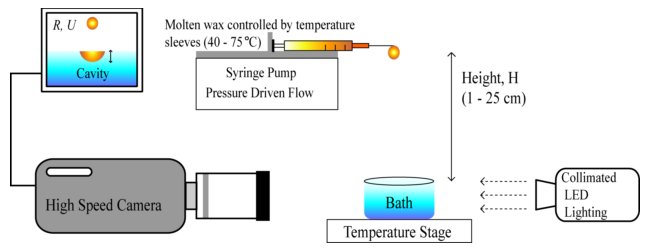
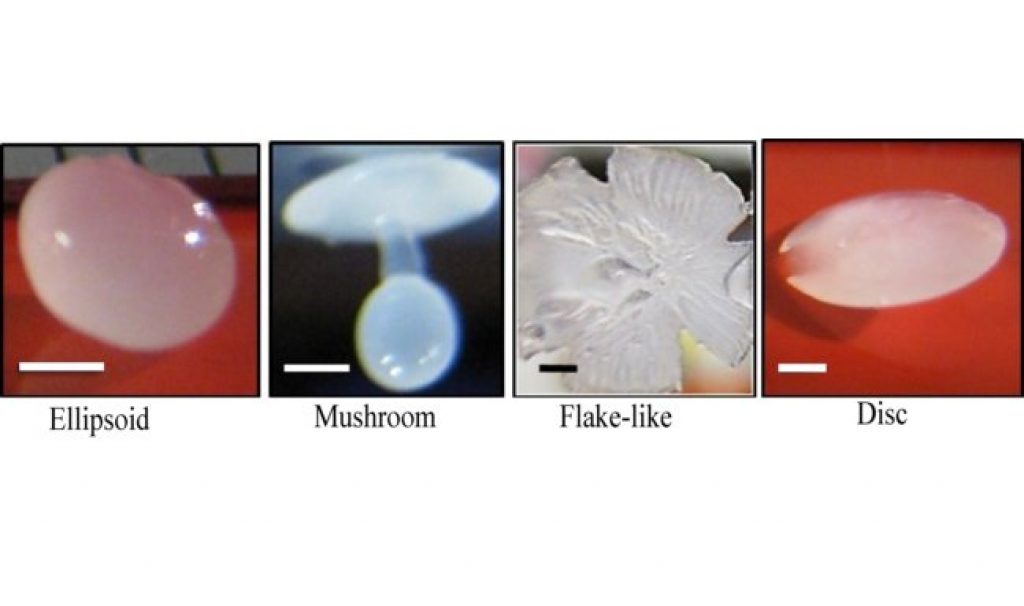
By balancing these different variables with competing time scales, four shapes presented themselves throughout the research: Ellipsoid, Mushroom, Flake-like, and Disc. In addition to the use of high speed image analysis, a simplified heat transfer model was used to estimate the time it takes for an individual molten wax drop to solidify after making contact with the cooling liquid bath. The resulting data allows for these four types of non-spherical shapes to be reliably reproduced and lays the groundwork for other types of particles to be created using similar methods.
Shen explains “People have done studies similar to this in the past using liquid metals impacting solid surfaces, but not other liquids. In terms of the fundamental physics, I believe this research is unique. In terms of applications it’s also very important because of how simple and low cost this method is as well as how easily it can be scaled.”
Wax based particles in particular with their low melting points would perhaps see use in the field of cosmetics but Professor Shen points out that similar methods can work with temperature sensitive polymeric and hydrogel materials, the same substances that are commonly used for capsules in pharmaceuticals, to provide new methods of making non-spherical capsules for drug delivery.
The article can be found at: Beesabathuni et al. (2015) Getting in Shape: Molten Wax Drop Deformation and Solidification at an Immiscible Liquid Interface.
———
Source: OIST.
Disclaimer: This article does not necessarily reflect the views of AsianScientist or its staff.