AsianScientist (Jan. 6, 2015) – Researchers from Tsinghua University have proposed an evolvable internet architecture to meet the changing demands of a growing number of users. Their solution, a middle ground between the clean-slate and dirty-slate approaches, has been published in SCIENCE CHINA Information Sciences.
From its beginnings as a private university network, the Internet has vastly expanded, now accessed by about one third of the world’s population. Accordingly, the role of the Internet has shifted from a “communication channel” to a “communication and data processing repository”. However, it has been difficult for the existing internet architecture to adapt to this change.
The clean-slate approach to reforming internet architecture involves a total overhaul of the underlying system, which could lead to serious deployment and transition problems. Conversely, the dirty-slate approach is more conservative, but can only solve a small range of local issues and comes at the cost of a more complex and cumbersome structure.
In the present study, Professor Xu Ke and his group from the Tsinghua National Laboratory for Information Science and Technology (TNList) have proposed a novel evolvable internet architecture instead. Designed based on three constraints—evolvability, economic adaptability and manageability—their solution provides a roadmap for technology realization.
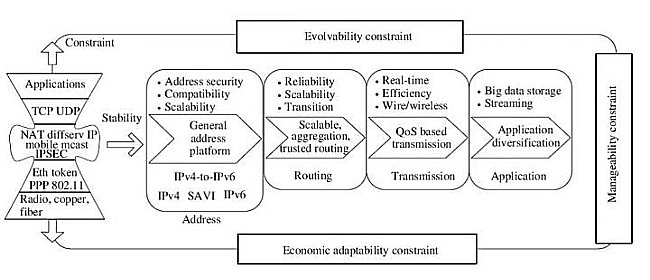
Compared with the dirty-slate approach, evolvable architecture is more flexible. Moreover, evolvable architecture is more stable compared with the clean-slate approach. On the one hand, the evolvable architecture makes reformation under the core design principle of the current architecture to achieve technology innovation as well as smooth transition from the existing architecture to a new one. On the other hand, it also relaxes the key constraints that limit the extension of the architecture with the aim of providing better support for application requirements.
To a large extent, the current internet address system directly determines the sustainable evolutionary ability of internet architecture. The semantic overload of internet protocol (IP) addresses, almost by design, prevents long-term evolution. Thus, the proposed evolvable Internet architecture has been designed as a general address platform which is able to support multiple address schemes natively and make evolution possible.
The implementation and promotion of evolvable internet architecture could have strong practical significance. The authors hope that their research will contribution towards the development of future internet architecture and provides an important reference for follow-up research.
The article can be found at: Xu et al. (2014) Towards Evolvable Internet Architecture-Design Constraints and Models Analysis.
——-
Source: SCIENCE CHINA Press; Photo: Shutterstock.
Disclaimer: This article does not necessarily reflect the views of AsianScientist or its staff.