AsianScientist (Nov. 24, 2014) – Researchers have identified two interdependent pain receptors in fly larvae, shedding light on how responses to pain are triggered. This research has been published in the journal Cell Reports.
Mechanical sensations—including touch sensation, sound sensation, pain sensation—are essential for animal survival. However, the molecular mechanisms linking mechanical sensation to downstream effects are just beginning to be elucidated.
Although it has long been known that mechanoreceptors respond to forces through mechano-gated ion channels—since the responses are too rapid to involve second-messenger cascade—the specific ion channels involved have only been recently identified. These include members of the TRP, DEC/ENaC and Piezo families, among others.
To date, 31 members of the DEG/ENaC channel family have been identified in the genome of the fly, Drosophila melanogaster. However, only two particular members—PPK and RPK—have been implicated in mechanosensation.
To discover novel DEG/ENaC channels that participate in mechanosensation, graduate students Guo Yanmeng and Wang Yuping from Dr. Wang Zuoren’s lab at the Institute of Neuroscience at the Shanghai Institutes for Biological Sciences, first performed a phylogenetic analysis of all the Drosophila DEG/ENaC channels and then examined the expression pattern of several candidates.
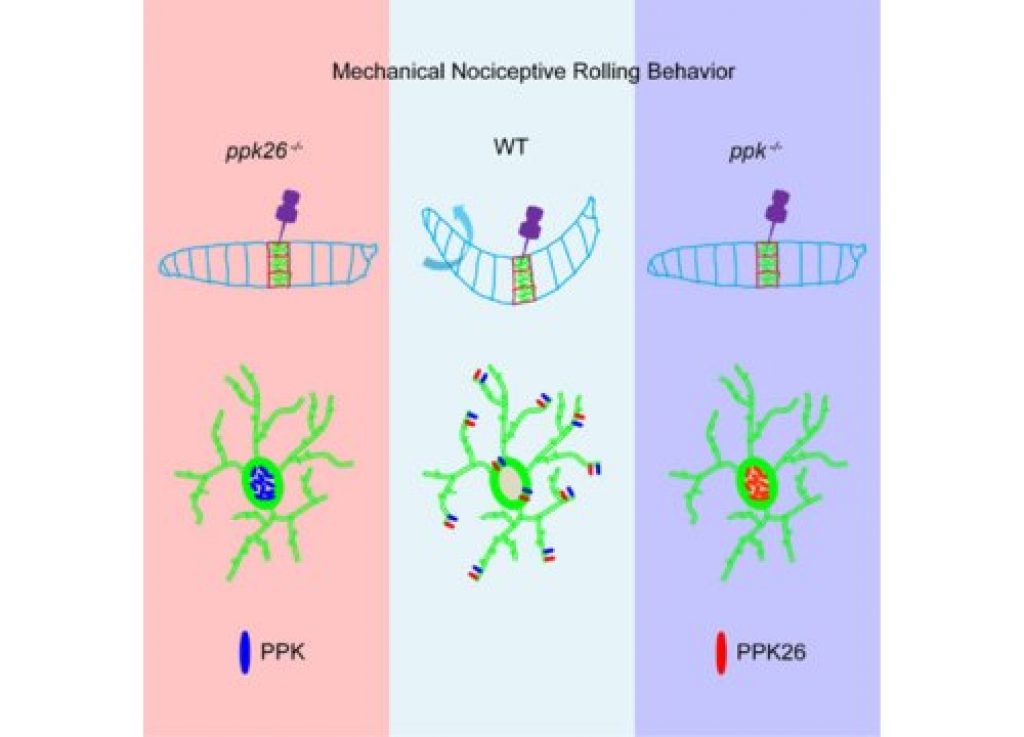
Combining use of functional silencing and immunostaining studies, they found that the protein PPK26 is selectively expressed in class IV dendritic arborization (da) neurons. The class IV da neurons detect intense mechanical forces and harmful heat as well as intense short-wave light in Drosophila larvae.
Previous work showed that PPK, Pain, and Piezo proteins all contributed to mechanical pain sensing (nociception) in the class IV da neurons. Here, the authors found that PPK26 contributes specifically to mechanical nociception but not to thermal nociception in class IV da neurons, functioning together with PPK.
Genetic interactions studies indicate that PPK26 and PPK function in the same pathway in mechanical nociception while Piezo functions in a parallel pathway. In consistent with this result, the authors found that PPK and PPK26 are interdependent on each other for their plasma membrane localization, while Piezo do not affect their plasma membrane localization. This work might provide new clues to future studies on mechanical nociception in mammals.
The article can be found at: Guo et al. (2014) The Role of PPK26 in Drosophila Larval Mechanical Nociception.
——–
Source: Shanghai Institutes for Biological Sciences.
Disclaimer: This article does not necessarily reflect the views of AsianScientist or its staff.