AsianScientist (Nov. 11, 2014) – Rather than disrupting the production of egg or sperm cells, a single mutation in the beta-catenin gene makes reproduction impossible by causing abnormalities in the morphology of sexual organs. The study documenting these findings has been published in the journal Scientific Reports.
Beta-catenin is an essential protein in the Wnt/beta-catenin signaling pathway, which has been shown in mice to be involved in the development and maintenance of most, if not all organs. Normally, it is switched on at specific points during development and turned off when it is no longer needed.
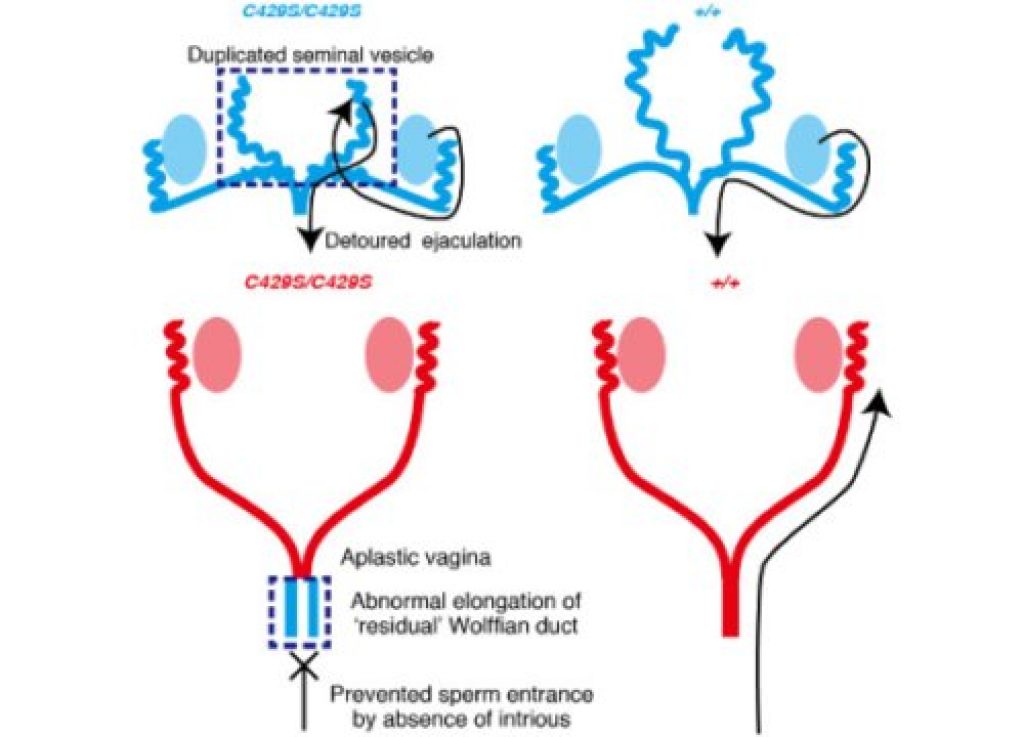
With the goal of discovering previously unknown functions of the evolutionary conserved protein, scientists from the RIKEN BioResource Center (BRC) in Tsukuba developed mice with single mutations in the beta-catenin gene. They found a strain where the mice were not able to produce offspring through natural mating, but were able to do so through in vitro fertilization, showing that the problem was caused by a structural problem rather than a problem with the eggs or sperm.
In these infertile mice, the beta-catenin pathway was not shut off properly in certain tissues, leading to malformations of the sexual organs, namely the seminal vesicles in males and vaginas in females, that prevented them from successfully reproducing.
This research could help to deepen our understanding of infertility—a problem that troubles almost one in ten couples today hoping to have a baby. The research has also elucidated a new function for the Wnt/beta-catenin pathway, which plays a role in regulating cell growth as well as cell-cell communication.
Dr. Takuya Murata of RIKEN BRC, the first author of the paper, says, “Because the amino acid sequence of beta-catenin is 100 percent identical in humans and mice, the nucleotide change we saw could cause the same mutation in humans. This raises the possibility that some infertility could be caused by β-catenin, which has not generally been considered as a potential cause so far.”
“This finding came as a major surprise because we were expecting to see effects on many organs, since the Wnt/beta-catenin pathway is so ubiquitous. But instead we found that the effects of this change were limited to specific organs.”
According to Dr. Yoichi Gondo, who led the research group, “Based on these results, we can confirm a link between infertility and this gene. This could lead to a path for the early detection and treatment based on the genetic diagnosis of the infertility.”
The article can be found at: Murata et al. (2014) β-cateninC429S Mice Exhibit Sterility Consequent to Spatiotemporally Sustained Wnt Signalling in the Internal Genitalia.
——-
Source: RIKEN.
Disclaimer: This article does not necessarily reflect the views of AsianScientist or its staff.