AsianScientist (Jul 7, 2014) – A new species of spider wasp, the ‘Bone-house Wasp,’ may use chemical cues from dead ants as a nest protection strategy, according to a recent study published in the journal PLOS ONE.
Wasps use a wide variety of nest protection strategies, including digging holes or occupying pre-existing cavities in wood. Previous studies showed that female wasps abandon their brood once they finish nest construction and do not care for their offspring anymore.
In this study, scientists were interested in understanding nest protection strategies, which play a crucial role in brood survival. To do this, the team led by Dr. Michael Staab from the University of Freiburg and aided by Dr. Zhu Chao-Dong from the Chinese Academy of Sciences, collected 800 nests of cavity-nesting wasps with 1900 brood cells belonging to 18 species in South-East China.
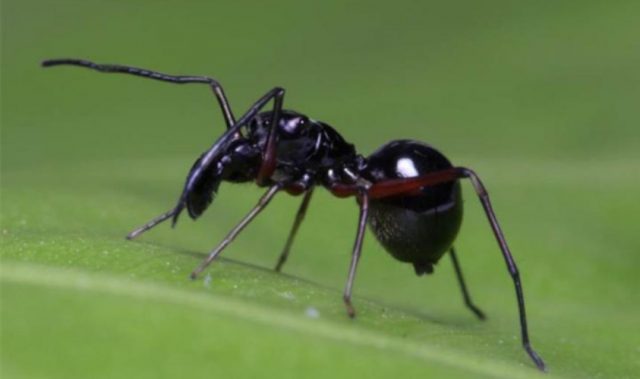
The scientists found a nesting behavior previously unknown in the entire animal kingdom: chemical protection via dead ants. In over 70 nests, they found an outer vestibular cell filled with dead ants. The species constructing these ant-filled vestibular cells have been named ‘Bone-house Wasps’ (Deuteragenia ossarium), after graveyard bone-houses or ossuaries.
The scientists also found lower parasitism rates in “Bone-house” nests than in nests of similar cavity-nesting wasps. The authors suggest that D. ossarium nests are less vulnerable to natural enemies thanks to the protection offered by the outer cell, which most likely involves chemical cues emanating from the dead ants used as nest-building material.
“Our discovery demonstrates in an impressive way, what fascinating strategies of offspring-protection have evolved in the animal kingdom,” Dr. Staab added.
The article can be found at: Staab et al. (2014) A Unique Nest-Protection Strategy in a New Species of Spider Wasp.
———
Source: Public Library of Science.
Disclaimer: This article does not necessarily reflect the views of AsianScientist or its staff.