AsianScientist (Jul 9, 2014) – Scientists have developed a carbon material that retains the beneficial characteristics of graphene but avoids the defects that commonly arise during graphene production.
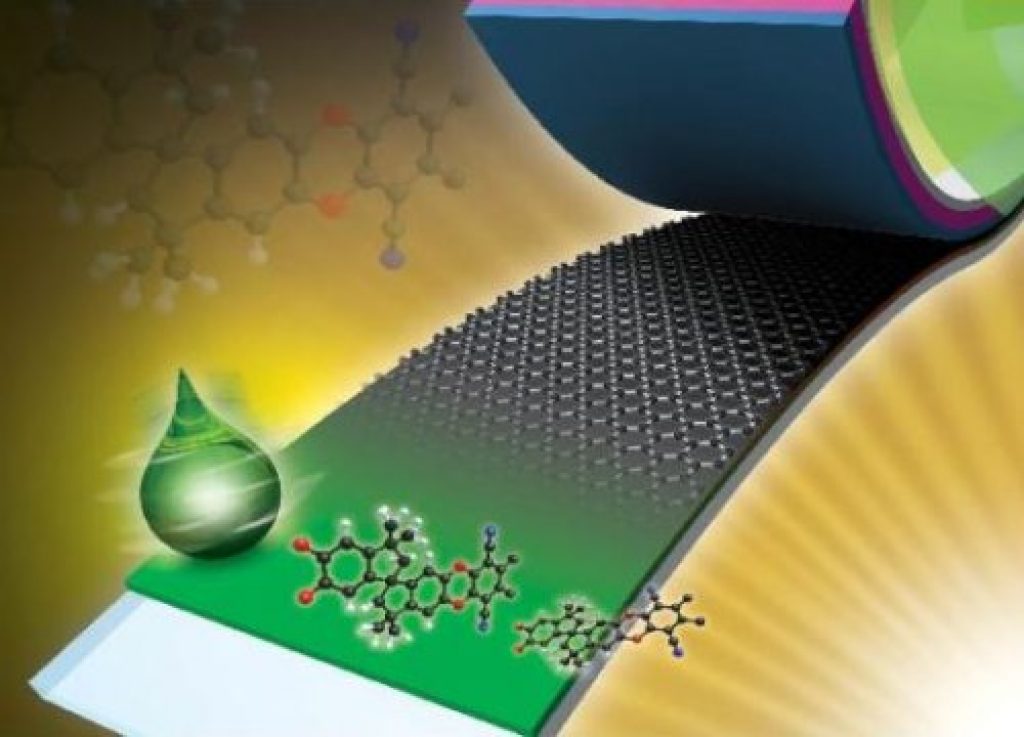
The newly developed material can be used as a substitute for graphene in solar cells and semiconductor chips. Furthermore, since the process is based on existing carbon fiber manufacturing methods, it is much easier to attain full-scale commercialization. In recognition of the innovative approach, the research was featured on the cover of Nanoscale.
To manufacture high quality graphene in large volume, the chemical vapor deposition method is widely used. However, this method requires intensive post-processing to remove excess metal and transfer of the manufactured graphene to another substrate. The post-processes degrade the quality of the graphene, causes wrinkles or cracks to form.
Instead, the research team led by Dr. Joh Han-Ik at the Korea Institute of Science and Technology (KIST) synthesized carbon nanosheets in a two-step process, first coating the substrate with a polymer solution and then heating it. This method is much simpler than the existing method which requires eight steps and results in a material that can be directly used as solar cell without any additional transfers.
To form the carbon nanosheets, the research team synthesized a polymer with a rigid ladder structure, namely Polymer of intrinsic microporosity-1 (PIM-1). They then spin-coated PIM-1 onto a quartz substrate and heated it to 1,200°C, resulting in a transparent and conductive carbon nanosheet that was shown to be as effective as graphene.
“We expect this technology to be readily applied in the commercialization-scale production of transparent and conductive 2D carbon materials since this process is based on the continuous and mass-produced process of carbon fiber,” said Dr. Joh.
The article can be found at: Son et al. (2014) One-Step Synthesis of Carbon Nanosheets Converted from a Polycyclic Compound and their Direct Use as Transparent Electrodes of ITO-free Organic Solar Cells.
——
Source: Korea Institute of Science and Technology.
Disclaimer: This article does not necessarily reflect the views of AsianScientist or its staff.