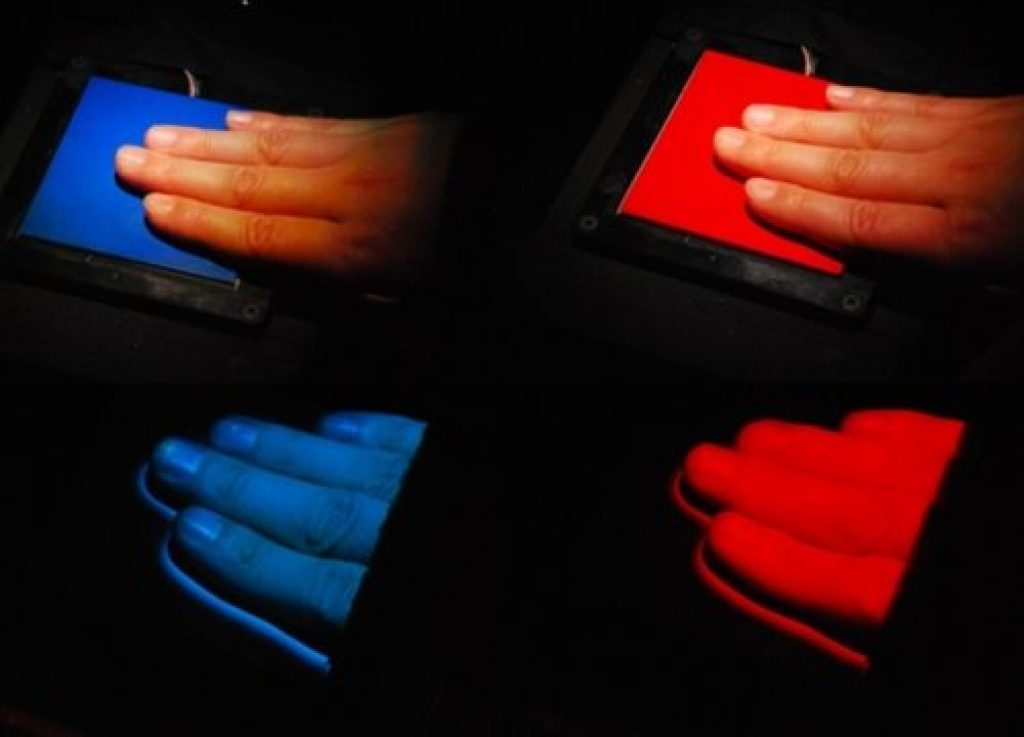
AsianScientist (Jul 7, 2014) – Colors can affect our perception of temperature, but not in the way that many might assume. A study showing that blue objects are more likely to be judged as warm than red objects at the same temperature has been published in Scientific Reports.
Colors have been documented to influence human emotion, a phenomenon exploited by interior designers and marketers. The color red is associated with subjective feelings of warmth while blue is linked to cold, a belief so widely held that hot and cold water taps are wordlessly labelled in red and blue respectively. However, most studies have focused on the indirect association between colors and temperature, without involving direct temperature sensing through contact.
In the present study, Dr. Ho Hsin-Ni from NTT Communication Science Laboratories and colleagues from Osaka University studied whether the color of an object would affect the temperature perceived by the hand. The found that blue objects were perceived to be warm at an average of 0.5°C lower than red objects. Although 0.5°C might not seem like a big difference, our hands are able to distinguish temperatures that differ by as little as 0.03–0.09°C, making 0.5°C a relatively large and clearly perceptible change.
Interestingly, when the subject’s hand rather than the object was colored red or blue, the reverse effect was seen, with red hands making objects feel warmer.
“When we look at a blue object, we expect it to be cold, because blue signifies cold,” explained Dr. Ho. “Since our brains anticipate a cold blue object, the actual temperature perception would be higher than the expectation and this contrast would make a blue object feels warmer than it actually is. Similarly, when we look at a red object, we anticipate a warm red object. Since the actual temperature perception would be lower than expectation, a red object would feel not as warm.”
“In the case of a red hand, our brain expects a red hand to already be warm, so a lower temperature would be enough for us to believe that the object in touch is warm. For a blue hand, our brain expects a blue hand to be cold, so a higher temperature is required for us to believe that the object in touch is warm. Thus, with a red hand people felt the object surface as warmer than with a blue hand.”
“In summary, the contrast between the expectation and actual temperature perception produces a perception that is opposed to the expectation. This is how a blue object would feel warmer than a red object.” she said.
These findings suggest that when confronted with differences between expectation and reality, the brain contrasts rather than averages the differences. This color-temperature contrast illusion is similar to the size-weight illusion, where larger objects are judges to be lighter than smaller objects of the same mass.
“It remains unanswered how the brain integrates information from the sense of sight and the sense of touch when exploring an object held in the hand. Our current finding provides a fresh insight into this fundamental question in neuroscience,” Dr. Ho said.
The group intends to broaden their research by investigating the influence of other aspects of visual information on tactile perception, such as temperature and surface roughness.
The article can be found at: Ho et al. (2014) Combining colour and temperature: A blue object is more likely to be judged as warm than a red object.
———-
Copyright: Asian Scientist Magazine; Photo: Ho Hsin-Ni.
Disclaimer: This article does not necessarily reflect the views of AsianScientist or its staff.