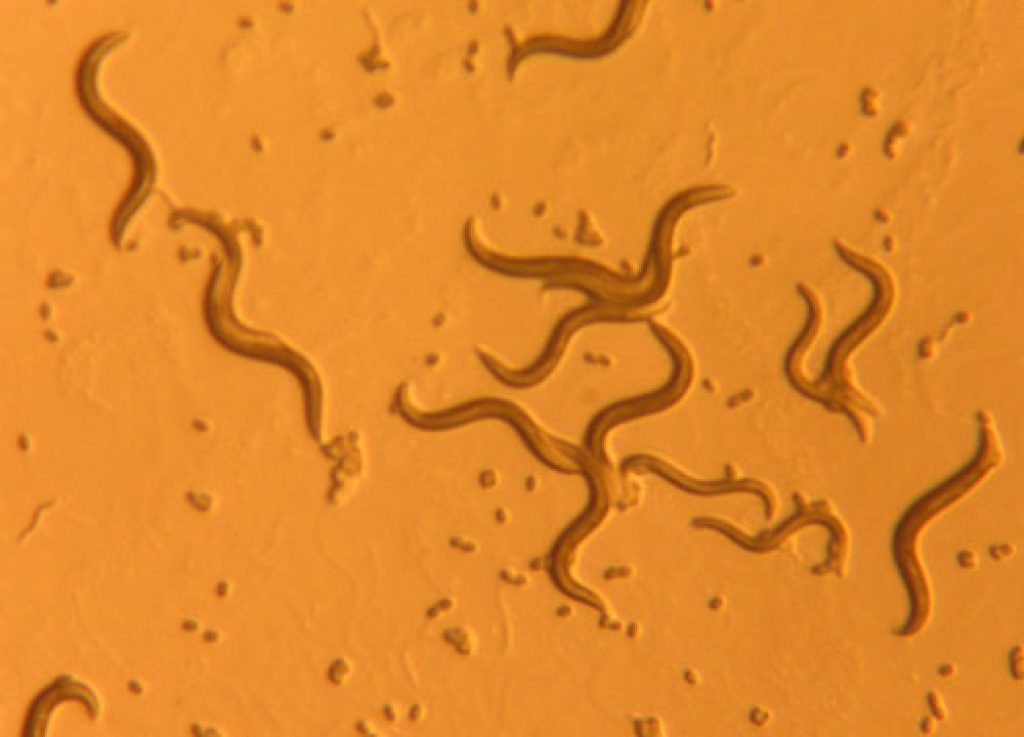
AsianScientist (Mar. 27, 2014) – Scientists have identified the pathways responsible for the avoidance of high alkalinity in the worm Caenorhabditis elegans, a behavior that is essential for survival.
A low pH indicates acidity, and a high pH indicates alkalinity. Substances either too low or too high in pH can cause extensive tissue damage or death. In humans, a difference of only 0.2 pH units in the blood can lead to extreme health problems. Normally, the body’s ability to sense pH prevents a serious problem from arising, but the mechanism allowing organisms to sense high pH are not well understood.
Members of Okinawa Institute of Science and Technology’s Information Processing Biology Unit, led by Prof Ichiro Maruyama, have recently uncovered the sensor for alkaline environments in C. elegans. They showed that when a specific sensing neuron, called the ASH neuron, was destroyed by laser microsurgery, the worms no longer avoided high pH.
Furthermore, the researchers narrowed down the focus to identify the specific proteins involved, the calcium channels osm-9 and ocr-2. They were able to visualize the influx of calcium that occurred in a neuron in response to stimulus in a living worm. When the two proteins that form the calcium channels were mutated, the neuron was no longer activated.
Co-authors Toshihiro Sassa and Takashi Murayama say, “We would like to identify the other genes involved in downstream signaling from this calcium channel to understand how the signal leads to aversion to high pH.”
The researchers would like to understand the genes and neuronal networks involved in regulating the avoidance behavior that occurs after high pH is sensed. The ability to study such complex neurological responses in a simple animal like the worm helps scientists understand the more complex systems that exist in humans.
The article can be found at: Sassa et al. (2014) Strongly alkaline pH avoidance mediated by ASH sensory neurons in C. elegans.
——
Source: Okinawa Institute of Science and Technology; Photo: snickclunk/Flickr/CC.
Disclaimer: This article does not necessarily reflect the views of AsianScientist or its staff.