AsianScientist (Dec. 4, 2013) – Learning from nature, researchers have revealed the bacterial killing potential of black silicon, leading the way for the development of a new generation of nanostructured antibacterial materials.
Black silicon is silicon that has been etched to create long narrow nanoprotrusions on its surface. Surfaces with similar features are common in the natural world.
Earlier this year, a team of researchers led by microbiologist Professors Elena Ivanova and Russell Crawford from the Swinburne University of Technology in Australia discovered that the wing of the cicada Psaltoda claripennis could shred certain types of rod-shaped bacteria through a process that arises from its physical structure.
“Based on this discovery, we investigated other insects that may possess similar surface architectures that might kill more bacteria, in particular the deadly strains of the Staphylococcus aureus or golden staph bacterium,” said Professor Ivanova.
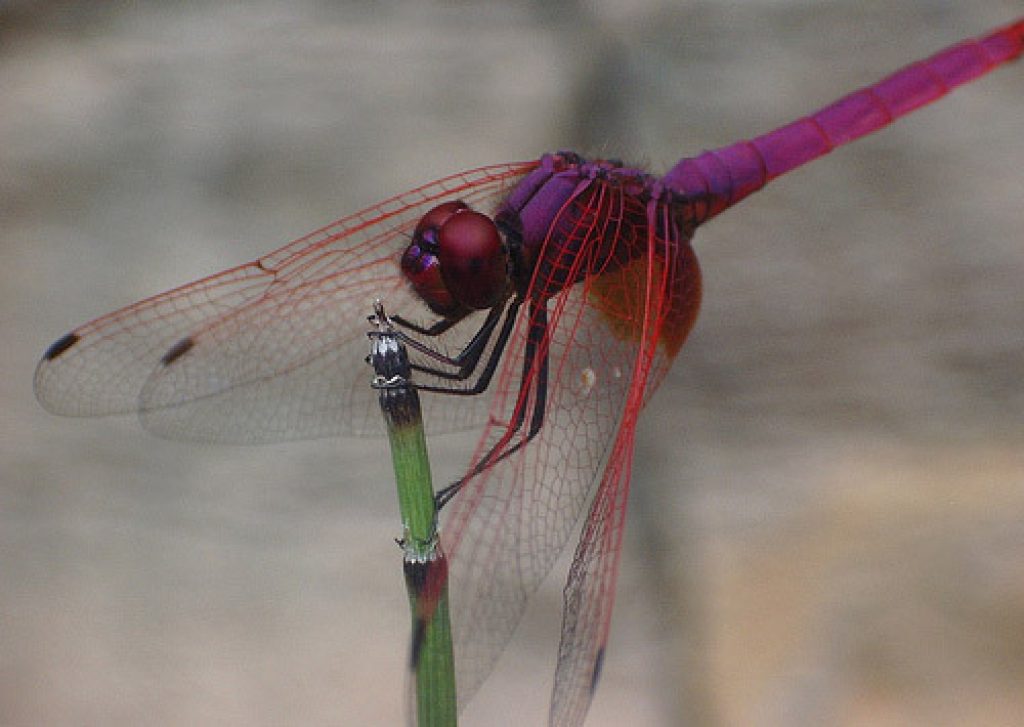
Their search led them to the wings of the Diplacodes bipunctata or Wandering Percher dragonfly, whose spike-like nanostructure kills both rod-shaped and spherical bacteria.
In a research study published today in Nature Communications, the team mimicked the surface structure of the dragonfly wing on the silicon surface, and compared the two surfaces and their bacteria-killing capacity. They demonstrate that both create a spike-like structure through the formation of clusters of multiple neighboring nanoprotrusions.
“This structure generates a mechanical bacteria killing effect which is unrelated to the chemical composition of the surface,” said Crawford. “Both surfaces were found to be highly effective against a range of bacteria, as well as endospores. They exhibited estimated average bacteria killing rates of up to 450,000 cells per minute of exposure, for every square centimeter of available surface.”
“This represents an exciting prospect for the development of a new generation of antibacterial nanomaterials that could be applied to the surfaces of medical implants, making them far safer,” he said.
The article can be found at: Ivanova E et al. (2013) Bactericidal activity of black silicon.
——
Source: Swinburne University of Technology; Photo: Shoops2011/Flickr/CC.
Disclaimer: This article does not necessarily reflect the views of AsianScientist or its staff.