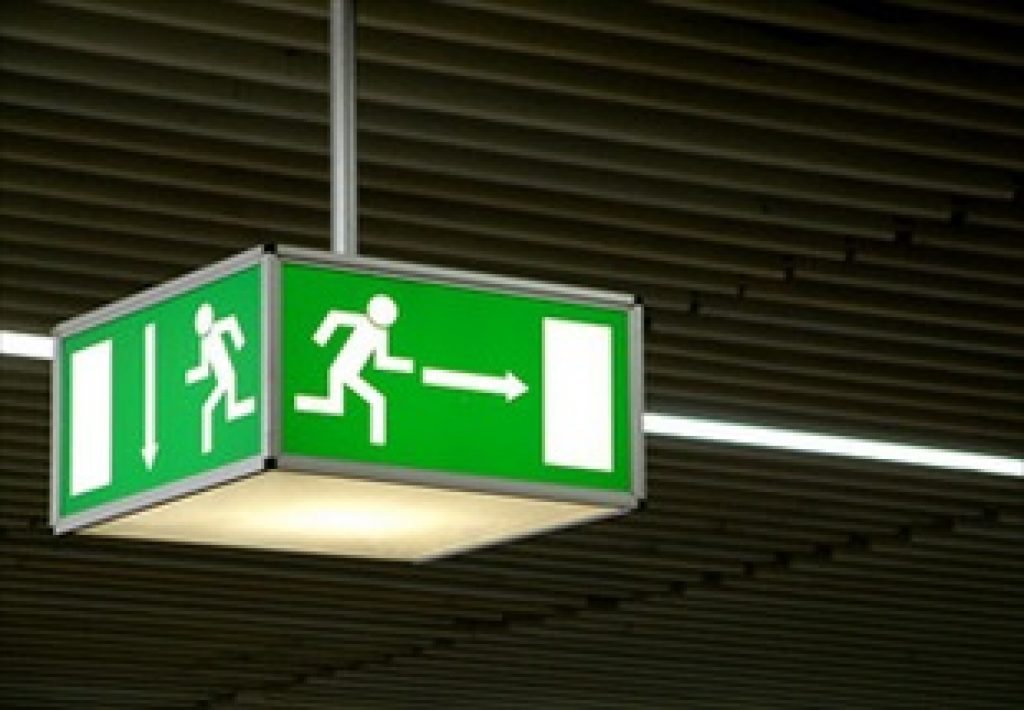
Asian Scientist (Jul. 2, 2013) – Engineers have observed the crowd movement of ants to help design exits that function more effectively during evacuations of large buildings and sporting arenas.
Crowd safety is emerging as an important issue worldwide following numerous incidents in which crowd panic has resulted in injuries and/or death.
In research published in Transportation Research: Part C, researchers used a nature-inspired approach to better understand human traffic flow.
Their observations can potentially help save lives in large-scale emergency situations when public infrastructure such as office buildings and sports arenas need to be evacuated quickly.
In their experiments, the researchers placed exits at several different locations: in the middle of a wall, at the corner, at the middle of a wall with a partial obstruction near the exit and at the corner with a partial obstruction near the exit.
They then observed ants as they moved toward the exits and out of the “room” in a simulated evacuation.
“We found the ants evacuated rooms faster when the exits were located in corners rather than in the middle of hallways,” said Dr Majid Sarvi, an author of the study.
“The location of the exit at the corner was 93.5 per cent more effective in reducing the evacuation time than when the exit was positioned in the middle of the wall.”
Dr Sarvi said the increased effectiveness of the corner exit could be due to the minimization of conflict points at the evacuation point.
“With the middle exit, ants escaping along both sides of the wall had to change their direction at the exit in order to evacuate. This created conflict with the ants moving straight towards the exit,” said Dr Sarvi.
“However, with the corner exit scenario, there were comparatively fewer conflicts with the ants moving straight towards to exit and those escaping from the side walls.”
The researchers then simulated a human evacuation scenario and found that the ant model prediction accurately predicted human traffic flow. They are now looking at enhancing the simulation capability of their method and conducting experiments with different insects.
The article can be found at: Shiwakoti et al. (2013) Enhancing The Panic Escape Of Crowd Through Architectural Design.
——
Source: Monash University; Photo: tacker/Flickr.
Disclaimer: This article does not necessarily reflect the views of AsianScientist or its staff.