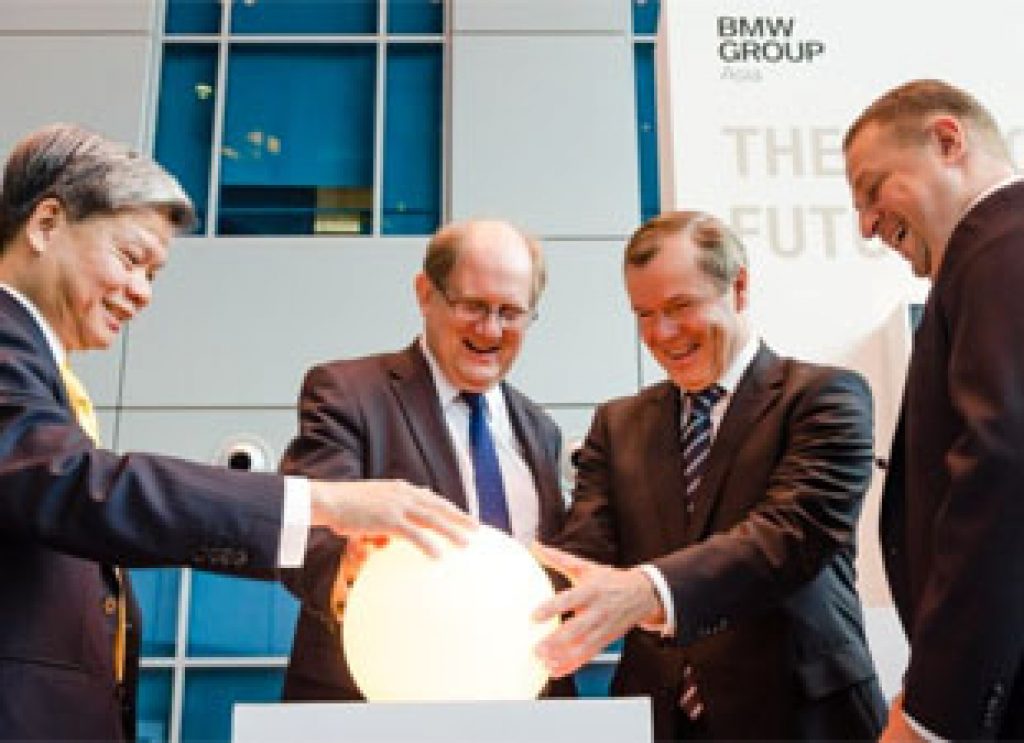
AsianScientist (Apr. 24, 2013) – BMW Group and Nanyang Technological University (NTU) today launched the joint Future Mobility Research Lab, the first for BMW Group in Southeast Asia.
This new research facility will study and develop key areas relating to future transportation, which includes advanced battery materials for electric vehicles, human-machine interfaces, and mobility patterns and concepts. A key focus will see how research outcomes can benefit the Asian market based on the needs of the region.
Located at NTU’s Research Techno Plaza, the new joint lab will start off with five scientists and six PhD student researchers. It will be led by Dr. Mirjam Storim, Coordinator of University Cooperations of BMW Group, and Professor Subodh Mhaisalkar, Director of the Energy Research Institute @ NTU (ERI@N).
Under the ambit of advanced battery materials and human-machine interfaces, the BMW Group-NTU collaboration aims to find solutions to key transport requirements in the most sustainable way possible, especially in the area of electric vehicles, where battery safety, efficiency and being environmentally-friendly is of utmost importance.
Projects by the joint lab will leverage the BMW Group’s expertise in automotive and mobility, as well as NTU’s research strengths, particularly that of ERI@N which carries out research in solar cells and other renewables, electric vehicles, energy and power systems, and battery technology in collaboration with industry.
“Singapore offers the setting of a highly-dense, urbanized mega-city, and is coincidentally inhabited with a highly sophisticated and tech-savvy population. By fulfilling the two key criteria that Future Mobility solutions are targeted at, Singapore became a natural choice for us to conduct this study in,” said BMW AG’s Senior Vice President, Dr. Kay Segler.
Other partners of the BMW Group include the Technical University of Munich (TUM), Georgia Institute of Technology, and the Massachusetts Institute of Technology.
——
Source: NTU.
Disclaimer: This article does not necessarily reflect the views of AsianScientist or its staff.