AsianScientist (Jan. 17, 2013) – Astronomers from Australia have discovered that supermassive black holes are growing much faster than was expected.
For years, scientists had believed that supermassive black holes, located at the centers of galaxies, increased their mass in step with the growth of their host galaxy. However, new observations have revealed a dramatically different behavior.
“Black holes have been growing much faster than we thought,” Professor Alister Graham from Swinburne University of Technology’s Center for Astrophysics and Supercomputing said.
Within galaxies, there is a competition of sorts for the available gas; for either the formation of new stars or feeding the central black hole.
For more than a decade the leading models and theories have assigned a fixed fraction of the gas to each process, effectively preserving the ratio of black hole mass to galaxy mass. New research published in The Astrophysical Journal reveals that this approach needs to be changed.
“We now know that each ten-fold increase of a galaxy’s stellar mass is associated with a much larger 100-fold increase in its black hole mass,” Graham said. “This has widespread implications for our understanding of galaxy and black hole coevolution.”
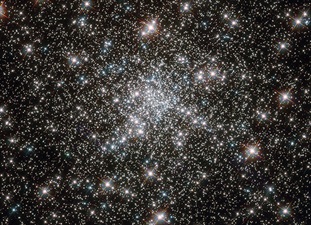
The researchers have also found the opposite behavior to exist among the tightly packed clusters of stars that are observed at the centers of smaller galaxies and in disk galaxies like our Milky Way.
“The smaller the galaxy, the greater the fraction of stars in these dense, compact clusters,” lead author Dr. Nicholas Scott said. “In the lower mass galaxies the star clusters, which can contain up to millions of stars, really dominate over the black holes.”
Previously it was thought that the star clusters contained a constant 0.2 percent of the galaxy mass.
The research also appears to have solved a long-standing mystery in astronomy. ‘Intermediate mass’ black holes with masses between that of a single star and one million stars have been remarkably elusive.
The new research predicts that numerous galaxies already known to harbor a black hole – albeit of a currently unknown mass – should contain these missing ‘intermediate mass’ black holes.
“These may be big enough to be seen by the new generation of extremely large telescopes,” Scott said.
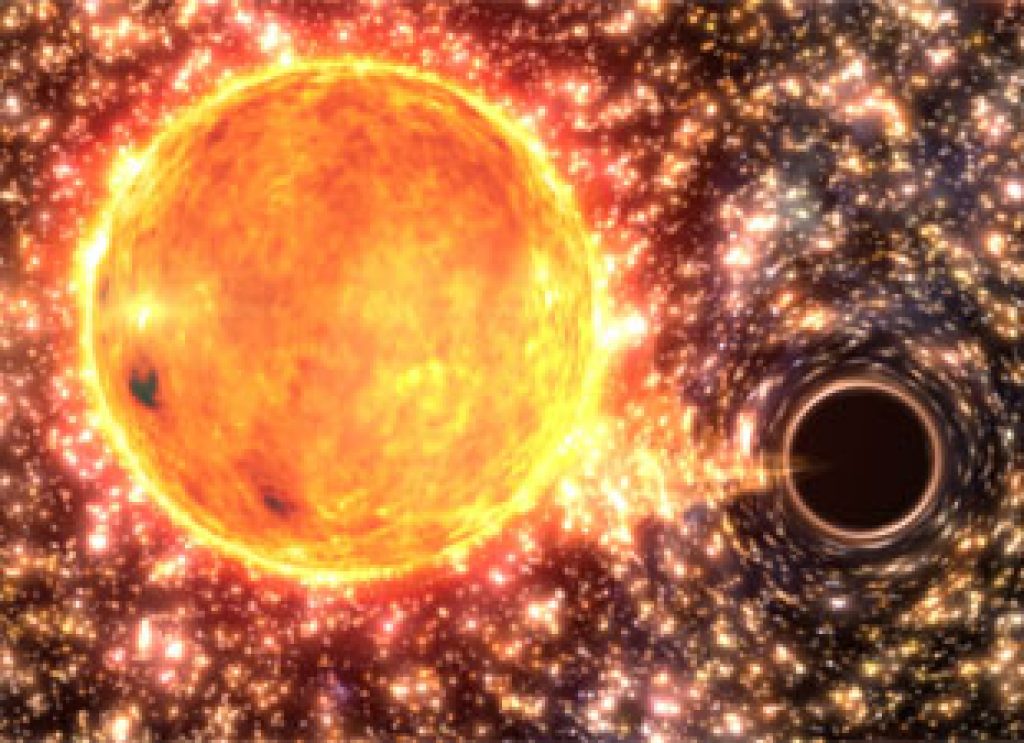
Professor Graham said these black holes were still capable of readily devouring any stars and their potential planets if they ventured too close.
“Black holes are effectively gravitational prisons and compactors, and this may have been the fate of many past solar systems,” Graham said. “Indeed, such a cosmic dance will contribute at some level to the transformation of nuclear star clusters into massive black holes.”
A short animation of stellar capture by a massive black hole:
The article can be found at: Scott N et al. (2013) UPDATED MASS SCALING RELATIONS FOR NUCLEAR STAR CLUSTERS AND A COMPARISON TO SUPERMASSIVE BLACK HOLES.
——
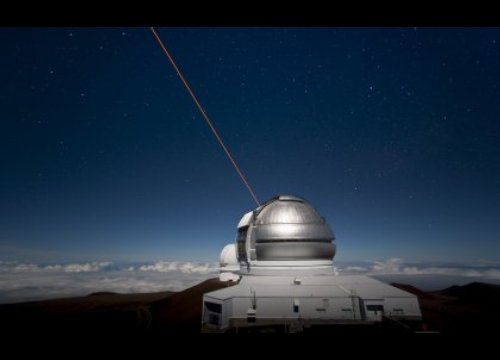
Source: Swinburne University of Technology; Photo: Gabriel Perez Diaz.
Disclaimer: This article does not necessarily reflect the views of AsianScientist or its staff.