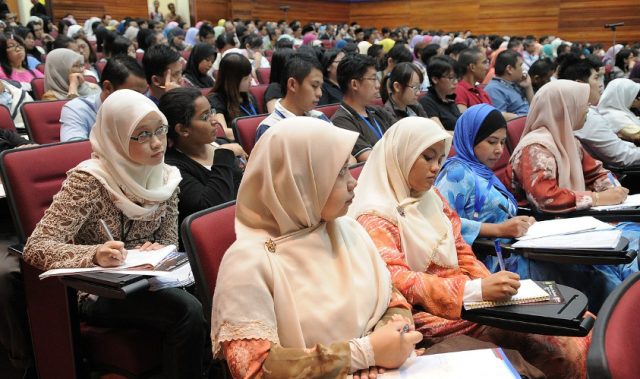
AsianScientist (Aug. 31, 2012) – A report released earlier this month by California-based think-tank, the Center for American Progress, has identified the economic competition from Asia as a challenge to be met with renewed commitment to educational reform in the U.S.
The U.S. economy has been suffering of late amidst the gloomy global business environment. But while this is a problem in most of the developed world, in the U.S., economic troubles have been brewing for a long time.
Recent economic growth has been only 60 percent of any other growth period in the last 70 years. From 1980 until 2011, the U.S. share of the world economy has shrunk from 25 percent to 19 percent.
On the other side of the world, the two main competitors of the U.S. have been gaining ground. India’s economic output has grown from 2.5 percent to 5.7 percent, while China’s has leaped from 2 percent to 14 percent.
Global labor arbitrage, referring to the substitution of high-wage workers in advanced economy countries with low-wage workers in developing economies, has led to a global shakeup of business norms and links between national economies.
Technological advances are pushing more U.S. industries such as computer programming, high-tech manufacturing and service sectors into the international arena.
In the face of Asian competition, there is a clear need for an American strategy that can exploit new opportunities appearing as other countries grow, while being responsive to modern economic challenges.
The need for more and better education
The CAP report identifies investment in education as the most important part of the strategy. The reasons for this are compelling. Harvard University economist Gregory Mankiw has shown that the positive effect of human capital investment on economic growth was triple that of investment in infrastructure.
According to Nobel Prize-winning economist James Heckman, the return on investment from prenatal care and early childhood programs is higher than for virtually any class of financial assets over time.
The U.S. as the world’s wealthiest nation already enjoys excellent living standards and invests heavily in education, which has fueled the engine of U.S. economic growth. However, there are numerous complex problems that must be tackled if the U.S. is to maintain its competitive edge, the authors say.
For example, half of U.S. children do not receive early childhood education, and there is currently no national strategy to increase enrollment. The number of children living in poverty has increased by almost 30 percent between 2007 and 2010. In addition, more than 25 percent of children suffer from a chronic health condition, such as obesity or asthma, which adversely affects their learning capacity.
The majority of U.S. post-secondary students drop out of school without receiving a degree. There are also large gaps in educational attainment and achievement between income and race groups, which have become entrenched over the years. Groups with disproportionately lower education achievement and poorer health, which includes African Americans and Hispanics, are on track to soon comprise a majority in the U.S. population.
Workplace policies are inflexible, where a vast 89 percent of U.S. workers do not have paid family leave, making child care very difficult for dual-earner and single-family households.
These problems reflect an urgent need for reforms if the U.S. wishes to maintain its lead in global competitiveness.

The rise of Asian skilled labor forces
Asia is home to the two biggest competitors of the U.S. who are also the world’s two most populous nations with the advantage of sheer numbers in terms of human capital. Moreover, both countries have placed emphasis on education at the core of their national economic strategy.
Between 1978 and 2006, China increased spending on social investments such as education and health by 58-fold, from less than US$2 billion to US$117 billion. In 2007, the Chinese surpassed the Americans in the numbers of college graduates with degrees in the fields of science, technology, engineering and maths (STEM). And in 2010, China became the world’s largest provider of higher education.
In the next decade, the Chinese aim to increase preschool enrollment by 50 percent to 40 million, while ensuring no child drops out of school for financial reasons. Another goal is to graduate 95 percent of Chinese youths through nine years of compulsory education and more than double the enrollment in higher education, which would lead to a doubling of the share of the working-age population to 195 million. That is more than the entire U.S. labor force.
While China faces big challenges such as rising inequality, the momentum behind its education-focused economic strategy is on track to make it increasingly competitive in sophisticated industries. This would bring it head-to-head with the U.S. who is currently leading the competition.
In India, the situation is similar. In 2008, India invested US$44 billion in education, four times more than in the late 1980s. By 2017, there will be 20 million high school graduates annually, which is five times as many as in the U.S. Over the last seven years, the number of university graduates with degrees in the STEM subjects has tripled.
While life for most children in India is hard, where 40 percent of families live on less than US$1.25 a day, India’s focus on its national education strategy will reap dividends over the next two decades.
To achieve their ambitions, both China and India are deploying a coordinated set of strategies that cover the whole spectrum of education from kindergarten through 12th grade to higher education. Importantly, there is additional focus on teacher quality and family support to complete the picture.
Will Asian competition spur education reform in the U.S.?
The CAP report recommends that lessons be learned by studying the U.S. middle class as well as best practices in European countries.
Children from middle-class families graduate from high school and college at higher rates, earn more than the average and are more likely to have a job with employer-sponsored health care benefits.
One reason for this is the attitude to education by their parents. Middle-class parents typically invest in early childhood education in the form of child care and are actively involved in educational development.
In Europe, students on average score higher on STEM subject tests than their American peers. Lower poverty rates than in the U.S. could contribute to educational success, and European countries have developed more generous social and pro-family policies to this end.
While Asian economies such as China and India are in a rapid “catchup” period of growth, developed economies such as Europe have been growing through innovation.
In the United Kingdom, investments in early childhood and pro-family services take the form of universal free preschool and community-based “children’s centers”.
To tackle teacher quality, Finland has transformed teaching into a highly selective, prestigious and rewarding profession. As a result, high school and college graduation rates have jumped, boosting Finland’s economic growth and helping it diversify into information technology and research sectors.
In Germany, education standards were federalized from the year 2000 and by 2009, 17 percent of students were competent at advanced math, compared with 10 percent in the U.S. Germany also places priority on workplace apprenticeships, where 2 million students are put into three years of apprenticeship training in 400 occupations.
Turning back to the U.S., there is already an understanding of how to improve and focus the educational system. However, the CAP report finds a lack of political will to push through the much-needed reforms.
The report calls on the U.S. president to convene the governors for a National Education Summit next year to make a renewed effort to improve educational outcomes by committing to Common Core national early education standards.
Renewed leadership on education as a national priority – and full support at all levels of government – is the best hope of the U.S. to remain economically competitive in the face of a changing world adjusting to the rise of Asia, say the authors.
The full report can be downloaded here (PDF, 1.05 MB): The Competition that Really Matters: Comparing U.S., Chinese, and Indian Investments in the Next-Generation Workforce.
——
Copyright: Asian Scientist Magazine; Photo: Renato Ganoza/Flickr.
Disclaimer: This article does not necessarily reflect the views of AsianScientist or its staff.