AsianScientist (Mar. 14, 2012) – Long distance space travel could create the ultimate ‘killer entrance,’ devastating your destination and anything around the arriving spacecraft, according to calculations by researchers from the University of Sydney.
The team, consisting of Professor Geraint Lewis and two honors students, has published their results on the effects of a warp on matter encountered in long distance space travel in the journal Physical Review D.
Proposed in 1994 by Miguel Alcubierre, a Mexican physicist, the Alcubierre warp drive is a theoretical tool that would allow spacecraft to travel long distances in space rapidly by deforming the space-time continuum in a bubble around the spaceship.
Alcubierre proposed this warp drive in 1994 as a way to travel faster than light, overcoming the limit on particles traveling at such speeds posed by Einstein’s theory of special relativity.
“What we’ve shown is that when this spacecraft decelerated to arrive at its destination, it would release high energy particles which would destroy anything near the spacecraft’s landing spot,” said Lewis.
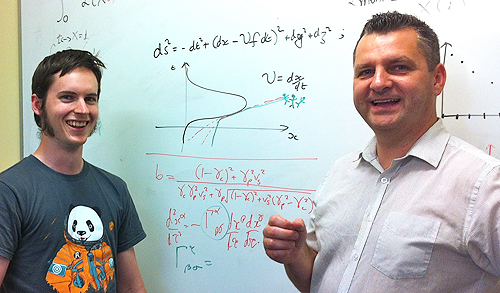
Unlike science fiction, Lewis noted that the Alcubierre warp drive completely obeys Einstein’s general theory of relativity.
While scientists have examined how it’s theoretically possible to create a bubble around a spacecraft with the Alcubierre warp drive compressing space-time in front of the bubble and expanding it behind the bubble, there has been little consideration of how this high-speed bubble would interact with particles of matter and light.
“Our calculations show that particles that come in contact with the warp bubble can get caught up and congregate in front of the spacecraft, and some particles even enter the warp bubble,” said Lewis.
Brendan McMonigal, one of the honors students working on the research, said that the energy burst released upon arriving at the destination does not have an upper limit.
“You can just keep on traveling for longer and longer distances and the energy that will be released will continue to increase – one of the odd effects of General Relativity.”
“Even for very short journeys the energy released is so large that you would completely obliterate anything in front of you,” said McMonigal.
Unfortunately for science fiction aficionados, the team has no solution to this conundrum, says McMonigal.
Human exploration of the universe may just have to wait for the team to work out how to avoid the destructive deceleration of a spacecraft in an Alcubierre warp drive bubble.
——
Source: University of Sydney.
Disclaimer: This article does not necessarily reflect the views of AsianScientist or its staff.