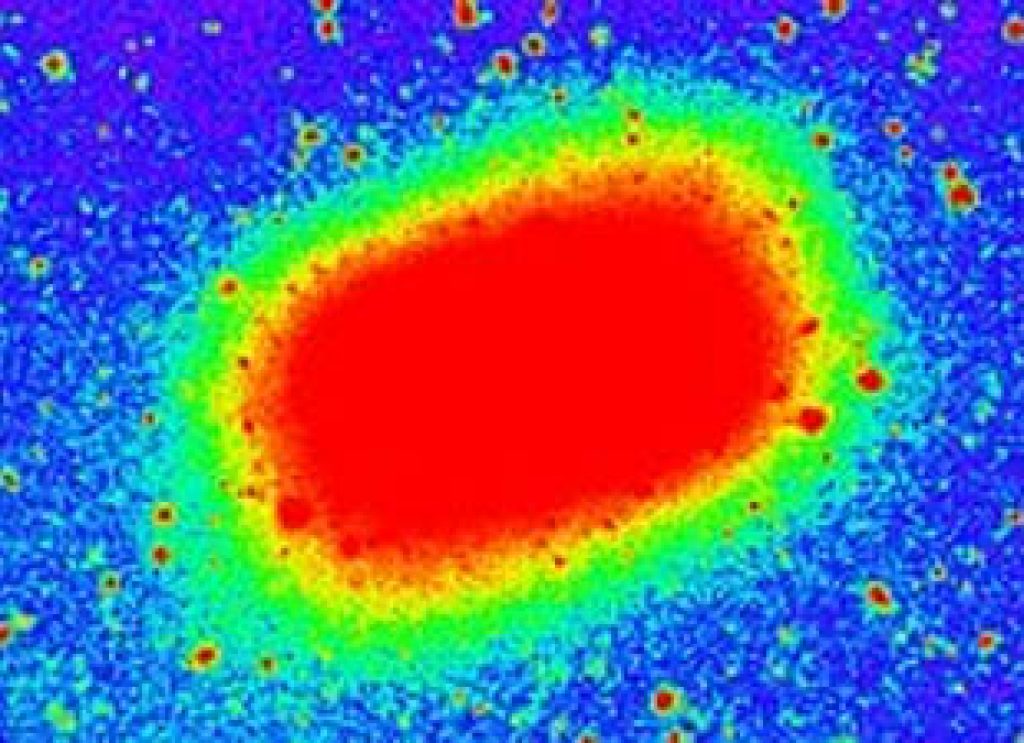
AsianScientist (Mar. 20, 2012) – An international team of astronomers has discovered a rare square galaxy, called LEDA 074886, which has a striking resemblance to an emerald cut diamond.
The astronomers – from Australia, Germany, Switzerland, and Finland – discovered the rectangular shaped galaxy within a group of 250 galaxies some 70 million light years away.
“In the Universe around us, most galaxies exist in one of three forms: spheroidal, disc-like, or lumpy and irregular in appearance,” said Associate Professor Alister Graham from Swinburne University of Technology.
He said the rare rectangular-shaped galaxy was a very unusual object, and compared it to the Leaning Tower of Pisa for defying the laws of nature.
The uniquely shaped galaxy was detected in a wide field-of-view image taken with the Japanese Subaru Telescope for an unrelated program by Swinburne astrophysicist Dr. Lee Spitler. Their latest findings are published in The Astrophysical Journal.
Based on this image alone, astronomers cannot rule out that the galaxy is shaped like a cube, although they believe it to be unlikely. Instead, they believe that LEDA 074886 may resemble an inflated disc seen side on, like a short cylinder.
Support for this scenario comes from observations with the giant Keck Telescope in Hawaii, which revealed a rapidly spinning, thin disc with a side on orientation lurking at the center of the galaxy. The outermost measured edge of this galactic disc is rotating at a speed in excess of 100,000 kilometers per hour.
“One possibility is that the galaxy may have formed out of the collision of two spiral galaxies,” said Professor Duncan Forbes, a co-author of the study.
“While the pre-existing stars from the initial galaxies were strewn to large orbits creating the emerald cut shape, the gas sank to the mid plane where it condensed to form new stars and the disc that we have observed.”
Despite its apparent uniqueness, partly due to its chance orientation, the astronomers have managed to glean useful information for modeling other galaxies.
While the outer boxy shape is somewhat reminiscent of galaxy merger simulations which don’t involve the production of new stars, the disc-like structure is comparable with merger simulations involving star formation.
“One of the reasons this emerald cut galaxy was hard to find is due to its dwarf-like status: it has 50 times less stars than our own Milky Way galaxy, plus its distance from us is equivalent to that spanned by 700 Milky Way galaxies placed end-to-end,” said Graham.
“Curiously, if the orientation was just right, when our own disc-shaped galaxy collides with the disc-shaped Andromeda galaxy about three billion years from now we may find ourselves the inhabitants of a square looking galaxy.”
The article (PDF): LEDA 074886: A remarkable rectangular-looking galaxy.
——
Source: Swineburne University of Technology.
Disclaimer: This article does not necessarily reflect the views of AsianScientist or its staff.