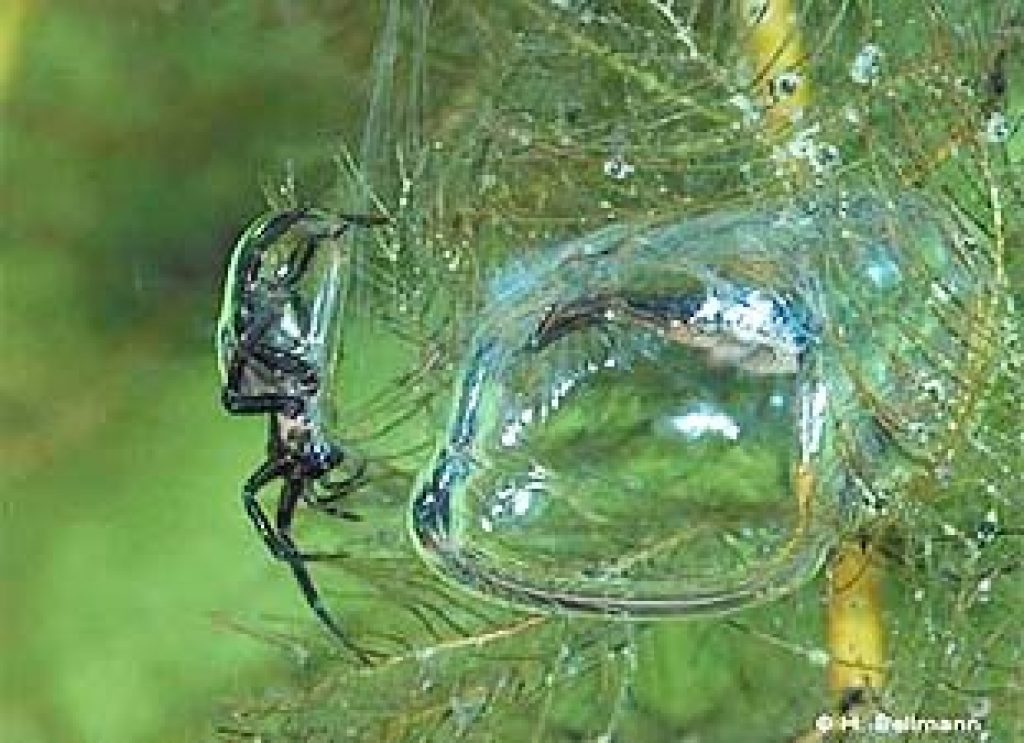
AsianScientist (Jun. 9, 2011) – Gazing into the depths of a pond, it is hard to miss the insects that whirl and zip beneath the surface. However, only one species of spider has joined them: the diving bell spider, Argyroneta aquatica.
According to Roger Seymour from the University of Adelaide, each spider constructs a net of silk in vegetation beneath the surface and fills it with air carried down on its abdomen. The spiders spend their entire lives submerged and even lay their eggs in their diving bells.
Together with Stefan Hetz from Humboldt University, Germany, the duo report their discovery that the spiders can use the diving bell like a gill to extract oxygen from water to remain submerged in The Journal of Experimental Biology.
Using diving bell spiders they collected from the Eider River, the team reproduced in their laboratory the conditions in a warm stagnant weedy pond on a hot summer’s day to find out how the spiders fare in the most challenging of conditions.
They then used an oxygen sensing optode to measure how much oxygen the spiders consume. Taking a series of oxygen measurements in the bubble and surrounding water, the team calculated the amount of oxygen flowing into the bubble before calculating the spider’s oxygen consumption rate and found that the diving bell could extract oxygen from the most stagnant water even on a hot day. Also, the metabolic rate of the aquatic spider was low and similar to the low metabolic rates of other spiders that sit waiting for prey to pass.
However, despite satisfying the spider’s oxygen demands, the bubble continually shrinks because nitrogen diffuses back into the water, eventually forcing the occupant to venture to the surface to resupply the diving bell. So how long could the bubble survive before the spider had to dash up for air?
“The previous literature suggested they had to come to the surface as often as every 20 min throughout the day,” said Seymour.
Calculating the diffusion rate of nitrogen out of the bubble, Seymour and Hetz were surprised to find that the spiders could sit tight for more than a day.
“It is advantageous for the spiders to stay still for so long without having to go to the surface to renew the bubble, not only to protect themselves from predation but also so they don’t alert potential prey that come near,” he adds.
The article can be found at: Seymour RS et al. (2011) The diving bell and the spider: the physical gill of Argyroneta aquatica.
——
Source: Journal of Experimental Biology.
Disclaimer: This article does not necessarily reflect the views of AsianScientist or its staff.