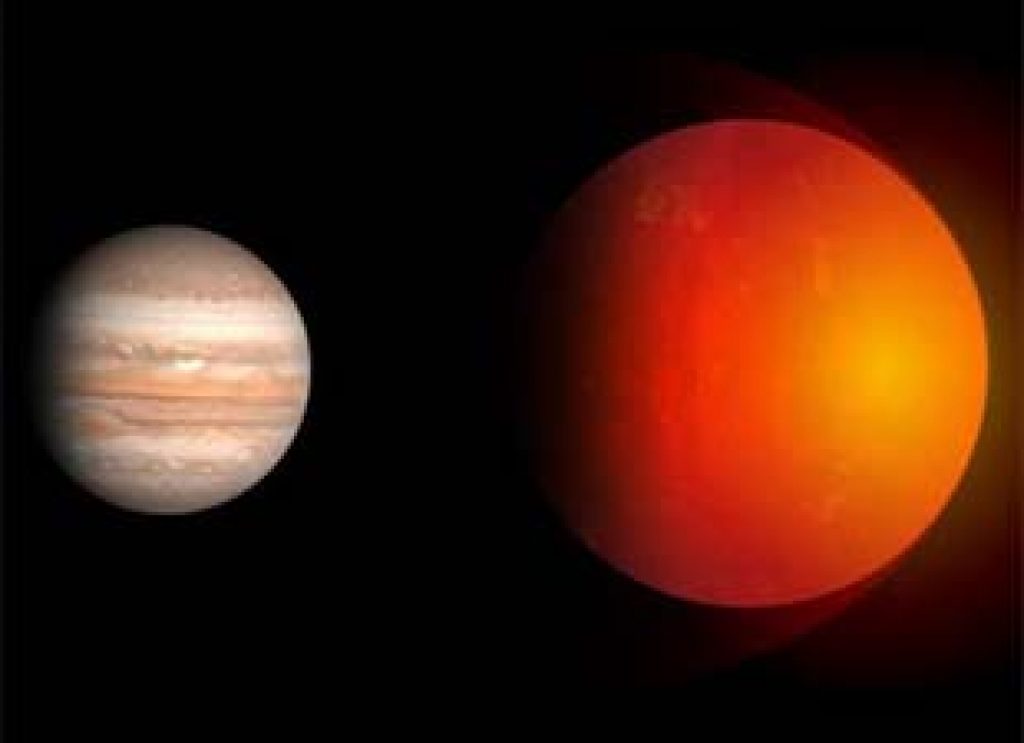
AsianScientist (Jun. 9, 2011) – All planets move around their stars in the same direction as the star spins – or so we thought. But now Australia National University (ANU) astronomer Dr. Daniel Bayliss and his colleagues have found a planet that breaks the mold.
Using one of the world’s largest telescopes in Chile, Bayliss and his collaborators discovered that a distant planet WASP-17b is moving in the opposite direction to the spin of the star around which it orbits. The discovery throws traditional theories about how planets form around stars into doubt.
Planets form from the same disk of rotating material that gives birth to the star around which they move. So until now it has been assumed that any planets orbiting a star would be moving in the same direction as the star’s spin. This is certainly true in our own Solar System.
WASP-17b is quite different, Bayliss says, and its backwards motion is somewhat of a mystery to scientists.
“It is possible that the planet underwent a close encounter with another giant planet billions of years ago, which altered its orbit so much that it began orbiting backwards,” he said.
It is not known what fraction of planets orbit their stars in this retrograde manner, but astronomers are now actively trying to monitor other distant planets to see how common it is.
If retrograde orbits were common, it would not bode well for the chances of life around other stars. Close encounters between giant planets would most probably destroy any small Earth-like planet in that system and wipe out any chance of life arising.
Related articles:
Australian Scientists To Build Super-Sized Telescope.
——
Source: Australian National University.
Disclaimer: This article does not necessarily reflect the views of AsianScientist or its staff.