



AsianScientist (Jan. 5, 2016) – Encapsulating pancreatic islet cells in a seaweed-derived gel could help preserve their function for transplantation into diabetic patients, according to a study published in Advanced Healthcare Materials.
Patients with type 1 diabetes have their insulin secreting cells destroyed by the immune system and require daily insulin injections. Pancreatic islet transplantation is an effective treatment that can dramatically reduce daily doses or even eliminate dependence on external insulin. However, while the transplantation procedure itself has been greatly improved in recent years, collection, preservation, and transportation of these cells are still very challenging.
Cryopreservation, or deep freezing, is the method commonly used for the islet preservation and transportation. Unfortunately, cells are often damaged during the freezing process by the formation of ice crystals that pierce cell membranes and reduce cell viability.
A multidisciplinary group of researchers led by Professor Amy Shen, head of the Micro/Bio/Nanofluidics Unit at the Okinawa Institute of Technology and Science Graduate University (OIST), has developed a novel cryopreservation method that not only helps to protect pancreatic islets from ice damage, but also facilitates real-time assessments of cell viability. Moreover, this method may reduce transplant rejection and, in turn, decrease use of immunosuppressant drugs, which can be harmful to patient health.
The technique employs a droplet microfluidic device to encapsulate pancreatic islets in hydrogel made of alginate, a natural polymer extracted from seaweed. These capsules have a unique microstructure: a porous network and considerable amount of non-freezable water.
There are three types of water in the hydrogel: free water, freezable bound water, and non-freezable bound water. Free water is regular water: it freezes at 0°C, producing ice crystals. Freezable bound water also crystallizes, but the freezing point is lower. Non-freezable bound water does not form ice due to the strong association between water molecules and the hydrogel networks.
Hydrogel capsules with large amounts of non-freezable bound water protect the cells from the ice damage and reduce the need for cryoprotectants, special substances that minimize or prevent freezing damage and can be toxic in high concentrations.
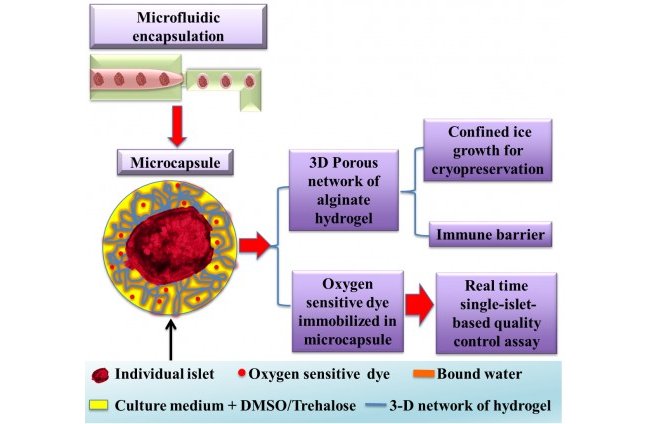
Another innovation proposed by the group is the use of a fluorescent oxygen-sensitive dye which functions as a real-time single-islet oxygen sensor. Fluorescence indicates whether cells are consuming oxygen and, therefore, are alive and healthy, while the porous structure of the capsules does not impede oxygen flow to the cells. It is a simple, time-efficient, and cheap method of assessing viability, both of individual islets or populations thereof.
Islet encapsulation also reduces the risk of rejection of transplanted cells by the recipient. The hydrogel capsule allows small molecules, e.g. nutrients and islet secretions, to pass through the membrane easily, but prevents direct contact between implanted islets and host cells. Encapsulation also may prevent an attack on transplants by the autoimmune response that destroyed the patient’s own islets in the first place.
The microencapsulation method could help to overcome some major challenges in pancreatic islet transplantation, including the scarcity of available islets and the lack of simple and reliable control methods, especially for individual islet assessment. It offers hope to patients suffering from type 1 diabetes to return to a ‘normal’ life, free of insulin injections.
The article can be found at: Chen et al. (2015) Sensing and Sensibility: Single-Islet-based Quality Control Assay of Cryopreserved Pancreatic Islets with Functionalized Hydrogel Microcapsules.
———
Source: OIST.
Disclaimer: This article does not necessarily reflect the views of AsianScientist or its staff.





