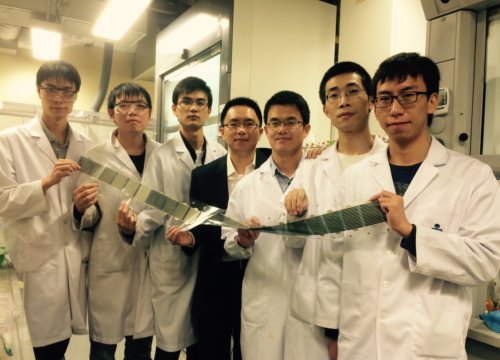
AsianScientist (Jan. 13, 2015) – Researchers have developed a simple strategy for trapping light and improving the optical absorption and efficiency of solar cells. The study, published in the Chinese Science Bulletin, uses aluminum foil in a nanobowl conformation and has achieved a 28 percent enhancement in power conversion efficiency.
Solar energy is one of the most promising renewable energy resources and represents a clean and ultimate replacement for fossil fuels in the future. Over the past decades, enormous efforts have been invested in developing efficient and cost effective photovoltaic devices which are competitive to the fossil fuel.
Organic photovoltaics (OPV) are regarded as one of the promising candidates for large-scale, low-cost and efficient solar energy harvesting. Typical OPV devices are fabricated on glass substrate and using indium-doped tin oxide as electrode. However, such substrate is not flexible and the relatively high resistance of ITO electrode will compromises the OPV device performance. Comparatively, an aluminum foil substrate has the advantages of excellent conductivity, flexibility, cost-effectiveness and roll-to-roll processibility.
Furthermore, the efficiency of solar cells can be further improved by using nano-textured substrates to increase light trapping. However, such applications for OPV have not yet been demonstrated, partly due to the more stringent requirement on active layer thickness uniformity for OPV devices which is hard to ensure with existing coating techniques.
In contrast, the novel nanobowl optical concentrator developed by Professor Fan Zhiyong from the Hong Kong University of Science and Technology (HKUST) can enhance the optical absorption in the active layer of organic solar cell and optical simulation.
In addition, Fan and his team have investigated the effect of geometry of nanobowl on the solar cell performance and three types of nanobowl with pitch of 1000 nm, 1200 nm and 1500 nm were studied. They found that solar cells based on nanobowl with pitch of 1000 nm exhibited the best photon absorption in photoactive layer leading to the highest short-circuit current density of ~9.41 mA/cm2 among all nanobowl substrates.
Their nanobowl solar cell achieved a solar energy conversion efficiency of 3.12 percent, representing a 28 percent improvement over the control device without nanobowl. This work has not only provided an in-depth understanding of light trapping by nanobowl optical concentrator, but also demonstrated the feasibility of implementing geometrical light trapping in low-cost, solution processible OPV.
The article can be found at: Qiu et al. (2015) Nanobowl Optical Concentrator for Efficient Light Trapping and High-Performance Organic Photovoltaics.
———–
Source: Science China Press.
Disclaimer: This article does not necessarily reflect the views of AsianScientist or its staff.